Learning how to apply for Social Security survivor benefits is one of the most practical steps you can take after losing a spouse, and the rules are more generous than many people realize. Survivor benefits can replace a meaningful share of household income at exactly the moment it matters most. Yet the process carries a few quirks that catch families off guard, including the fact that you cannot complete it online. The good news is that the path is straightforward once you know the steps. At Even Path, we help people coordinate survivor benefits with the rest of their financial picture so the timing works in their favor. Our retirement planning service exists to make decisions like this one clear and unhurried.
Recently lost a spouse and unsure where to start?
The Even Path team helps you claim the right benefit at the right time, coordinated with your full retirement picture. → Schedule a planning conversation
TL;DR: How to Apply for Social Security Survivor Benefits
To apply for Social Security survivor benefits, you contact the Social Security Administration by phone or in person, because survivor claims cannot be filed online. A surviving spouse generally qualifies at age 60, or at 50 if disabled, or at any age while caring for the deceased’s young child. Divorced spouses can qualify too if the marriage lasted at least 10 years. The benefit ranges from 71.5 percent of the deceased’s benefit at age 60 up to 100 percent at your full retirement age. Because survivor benefits follow different rules than retirement benefits, you can often claim one first and switch to the other later, which can add tens of thousands of dollars over a lifetime. The application itself is simple. The strategy behind it is where careful planning pays off.
Key Points
You cannot apply online. Survivor benefits must be claimed by phone or at a local Social Security office, unlike retirement benefits.
Eligibility starts earlier than you think. A surviving spouse can qualify as early as age 60, or 50 if disabled, and at any age when caring for the deceased’s child under 16.
Divorced spouses often qualify. If your marriage lasted at least 10 years, you may claim survivor benefits on a former spouse’s record.
The amount depends on your age. Benefits range from 71.5 percent of the deceased’s benefit at 60 to 100 percent at your full retirement age.
A $255 lump sum is available. A one-time death payment is payable to an eligible surviving spouse, and you must request it.
You can switch benefits later. Survivor and retirement benefits follow separate rules, so claiming one now and switching later is often the smartest move.
Gather documents before you call. Having the death certificate, Social Security numbers, and marriage records ready makes the process far smoother.
Even Path coordinates the timing. We model how survivor benefits fit your full income plan so you claim the most over your lifetime.
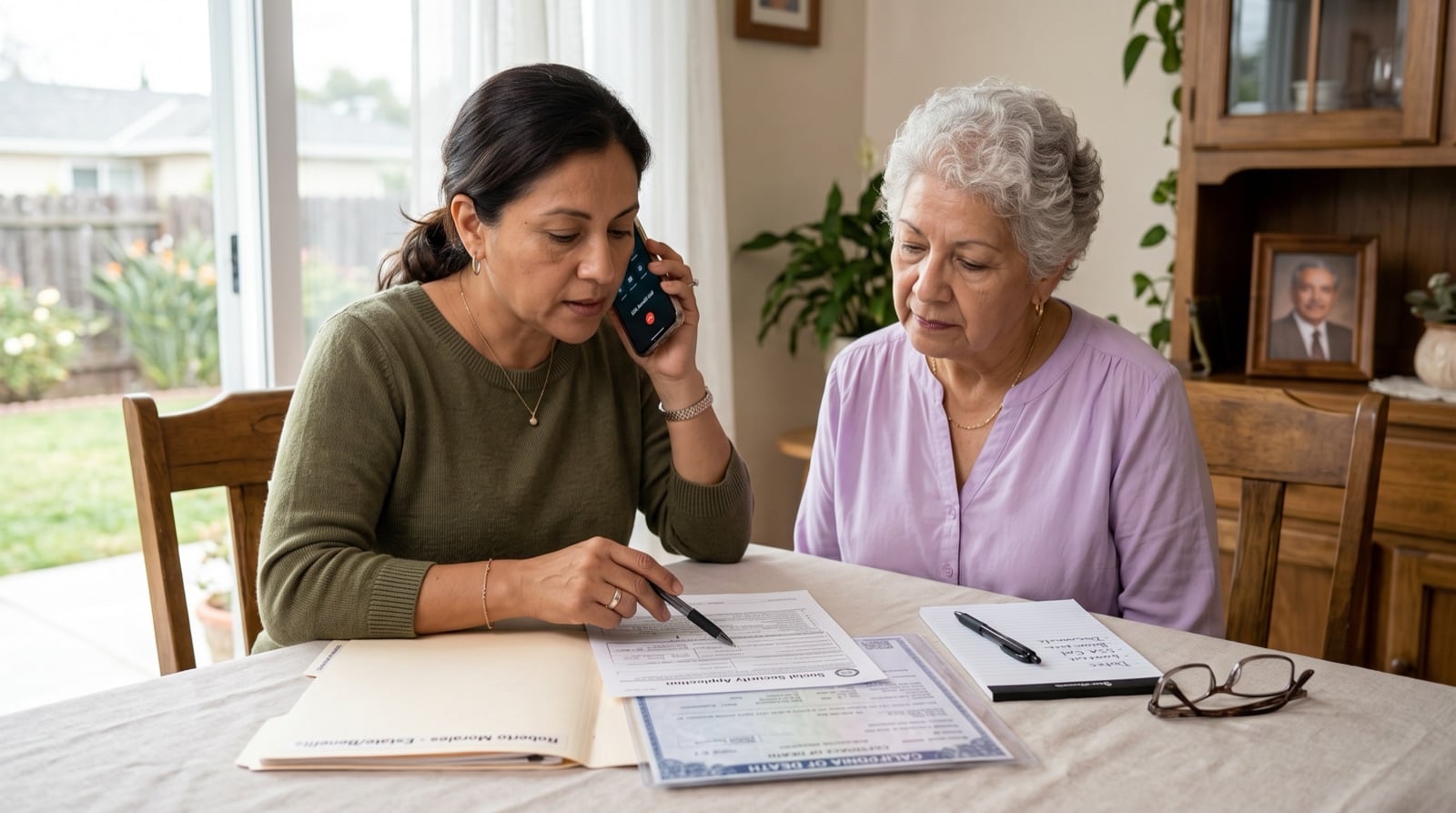
What Social Security Survivor Benefits Are, and Who Qualifies
Before the application itself, it helps to understand what these benefits are and who can receive them. Survivor benefits are monthly payments to the family of a worker who paid into Social Security and has died.
The Purpose of Survivor Benefits
Survivor benefits exist to replace part of the income a family loses when a wage earner dies. Unlike a life insurance payout, they arrive as ongoing monthly support rather than a single lump sum. According to the Social Security Administration, these benefits reach millions of widows, widowers, children, and dependent parents each year. For many surviving spouses, this income becomes a foundation of their retirement security.
The amount is based on the deceased worker’s earnings record. Therefore, a spouse who earned less, or who stepped away from work to raise a family, often receives far more through survivor benefits than through their own record. This is one reason the benefit matters so much for the lower-earning spouse.
A nonpartisan overview from the Congressional Research Service explains that survivor benefits have been part of Social Security since 1939, designed to protect the family as a unit rather than just the worker. That history matters because it shaped a system meant to keep a surviving spouse from falling into poverty after a loss. Understanding the intent helps you see these benefits as a right you have earned, not a favor you are requesting.
Who Is Eligible
Eligibility is broader than most people assume. The SSA’s survivor eligibility rules cover several groups. A surviving spouse generally qualifies at age 60, or at age 50 if they have a qualifying disability. A surviving spouse of any age qualifies while caring for the deceased’s child who is under 16 or disabled. Children themselves may qualify, as may dependent parents in some cases.
Divorced spouses deserve special attention here. If your marriage to the deceased lasted at least 10 years and you have not remarried before age 60, you can usually claim survivor benefits on your former spouse’s record. Furthermore, claiming on an ex-spouse’s record does not reduce benefits for anyone else in their family.
How Survivor Benefits Differ From Spousal Benefits
People often confuse the two, but they are not the same. Spousal benefits apply while both spouses are living and cap at 50 percent of the worker’s benefit. Survivor benefits apply after a death and can reach 100 percent of the deceased’s benefit. A clear plain-language overview from AARP reinforces the same distinction for anyone who wants a second reference. Our guide on Social Security spousal benefits after divorce covers the living-spouse side, while this guide focuses on what happens after a loss.
One more point surprises people. A surviving spouse under 65 does not automatically receive Medicare along with survivor benefits, since Medicare eligibility generally begins at 65 on its own timeline. Planning for that health-coverage gap belongs in the same conversation as the benefits themselves.
Before You Apply: What to Gather
A little preparation makes the application far smoother. Because you will speak with a representative directly, having your documents ready lets you finish in one conversation rather than several.
The Documents You Will Need
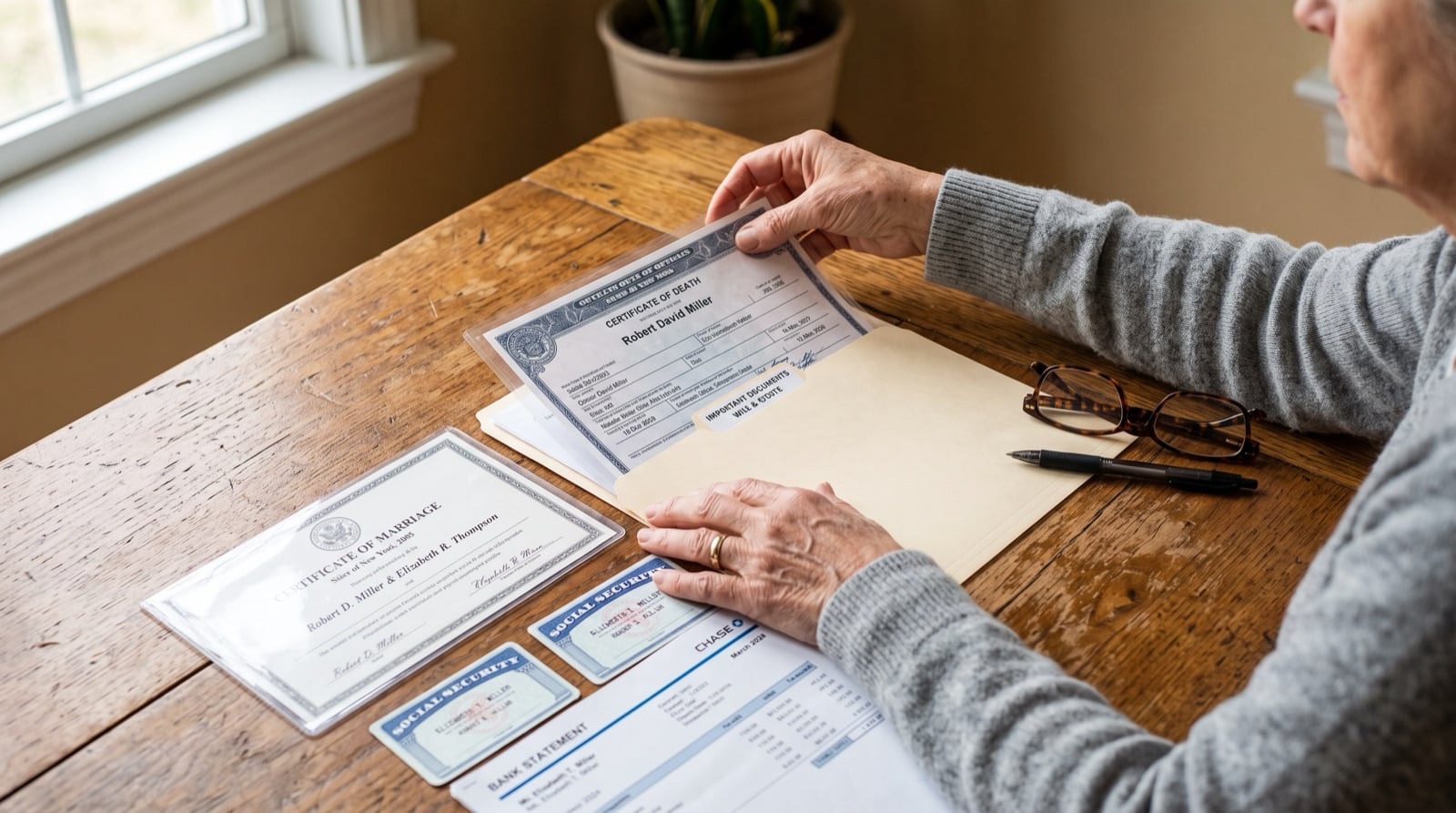
Collect the core records before you call. The SSA’s survivor benefits publication lists what helps most. You will want the deceased’s Social Security number and your own, a death certificate, your birth certificate, and your marriage certificate. If you are claiming as a divorced spouse, add your divorce papers. You will also want the deceased’s most recent tax return or W-2 and your bank details for direct deposit. Keeping these in one folder saves you from hunting for a single missing item mid-application.
If you cannot find every document, do not let that stop you from applying. The SSA can often verify records on its end, and a representative will help you fill any gaps. Applying promptly matters more than having a perfect file.
When to Reach Out
Timing is important. Some survivor benefits begin from the month you apply rather than the month of death, so a delay can mean lost income. In addition, the one-time death payment has a filing deadline. As a result, it is wise to contact Social Security soon after a death, even while other arrangements are still in motion.
If you already receive spousal benefits when your spouse dies, the SSA will often convert you to survivor benefits automatically. However, you should still call to confirm the amount and to request the lump-sum death payment, which is not automatic. A short call now can prevent months of receiving less than you are owed.
How to Apply for Social Security Survivor Benefits Step by Step
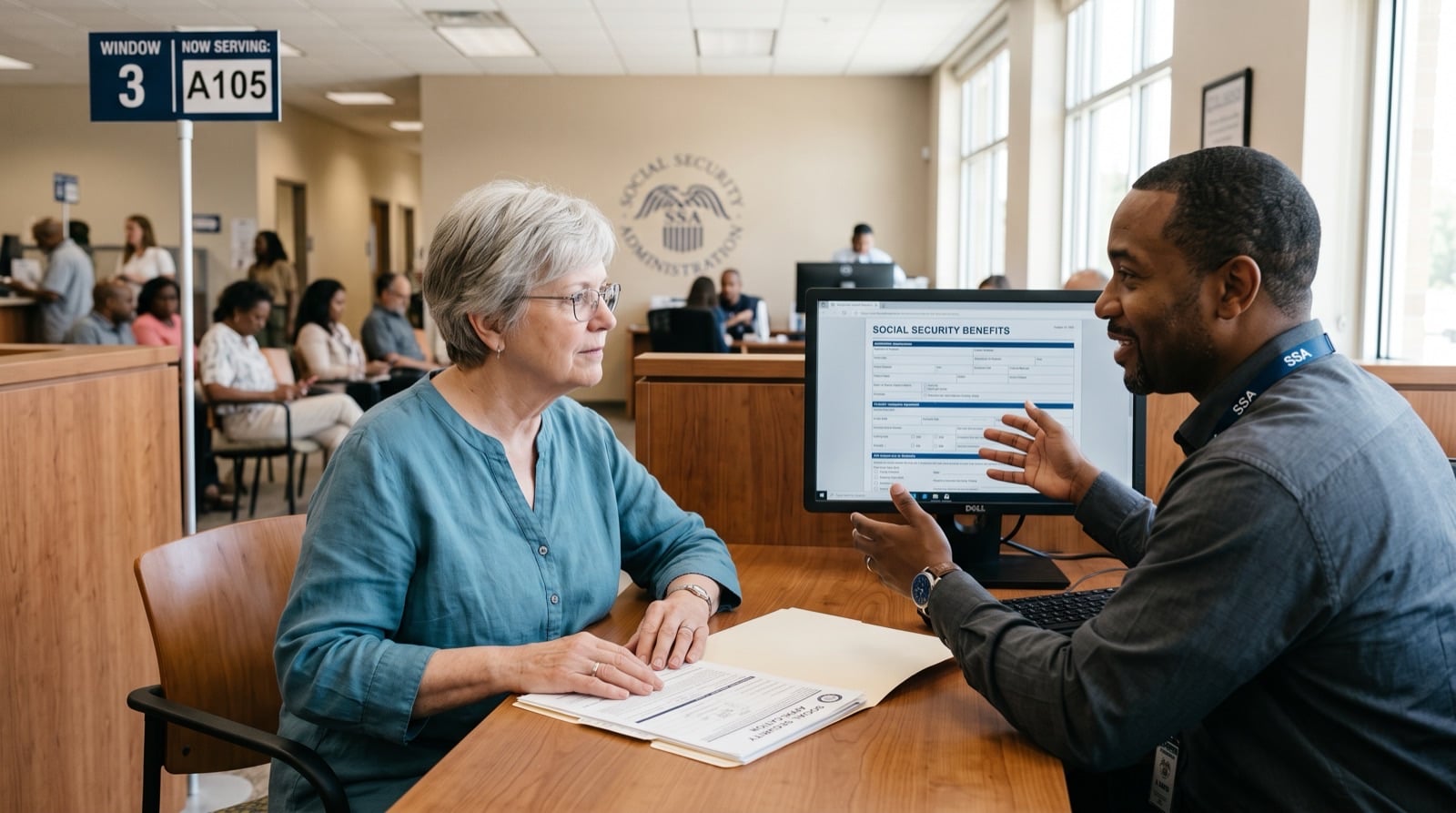
Here is the part that trips people up. You cannot apply for survivor benefits through the SSA website the way you can for retirement benefits. The process runs by phone or in person, and knowing that in advance saves frustration.
Step One: Contact Social Security
Start by calling the SSA at its national number, 1-800-772-1213, or by scheduling an appointment at a local office through the SSA office locator. For a smoother call, reach out early in the day or later in the week, when wait times tend to be shorter. Tell the representative that you are applying for survivor benefits and, if relevant, the one-time death payment.
Step Two: Complete the Application With a Representative
A representative will walk you through the application, which for a surviving spouse is the Application for Widow’s or Widower’s Benefits. You can request the $255 lump-sum death payment in the same conversation. Because a person guides you through each question, you do not have to interpret the forms alone. This is one case where the absence of an online option actually works in your favor. The representative can also flag benefits you might not have known to ask about, such as payments for a minor child or a dependent parent. Answer their questions fully, and mention any prior marriages that lasted 10 years or more, since those can open additional options.
Step Three: Confirm Timing and Payment
Once your application is submitted, ask the representative two questions. First, when will payments begin? Second, which benefit are you receiving now, and could a different claiming age serve you better? Processing typically takes several weeks. Meanwhile, keep a record of your application date, since that date can affect when your benefits start.
Want to claim the largest benefit you are entitled to?
Even Path models survivor and retirement benefits side by side so you know exactly when to claim each one. → Run your numbers with us
How Much You Will Receive
The size of a survivor benefit depends mostly on one factor: your age when you claim. Understanding the scale helps you decide whether to claim now or wait.
The Age-Based Sliding Scale
A survivor benefit ranges from 71.5 percent of the deceased’s benefit at age 60 up to 100 percent at your survivor full retirement age. That full retirement age falls between 66 and 67, depending on your birth year. The SSA’s survivor benefit amount page lays out the steps in between. Claiming at 60 locks in the lowest percentage for life, while waiting until full retirement age secures the full amount. A surviving spouse caring for a young child receives 75 percent at any age, and children generally receive 75 percent as well. Notably, the survivor full retirement age is calculated separately from the one used for your own retirement benefit, so the two milestones may not line up.
The figures below show how the benefit climbs with each year you wait. Seeing the curve makes the tradeoff concrete.
Every year you can wait raises the benefit for life. The right timing depends on your full income picture, not age alone.
The Family Maximum and the Death Payment
Two more rules shape the total. A family maximum limits the combined benefits paid on one record, usually between 150 and 180 percent of the worker’s benefit, so large families may see individual amounts reduced. Separately, a one-time death payment of $255 is available to an eligible surviving spouse. It is modest, but you must request it, because the SSA does not send it automatically.
The Claiming Strategy That Protects Your Income
This is where the real value lies. Survivor benefits follow different rules than retirement benefits, and that difference creates a planning opportunity most people never use.
Why You Can Switch Benefits
Unlike retirement and spousal benefits, survivor benefits are not subject to deemed filing. In plain terms, that means you do not have to claim everything at once. You can claim a survivor benefit first and let your own retirement benefit grow, or claim your own benefit first and switch to a survivor benefit later. The SSA confirms that you choose the higher payment and can change strategies over time.
Consider a common example. A surviving spouse might claim a reduced survivor benefit at 60, then switch to their own retirement benefit at 70 once it has grown to its maximum. Alternatively, someone with a small survivor benefit might claim their own first and switch later. The right order depends on the two benefit amounts and your health and income needs.
Watch the Earnings Limit
If you claim before your full retirement age and continue working, an earnings limit applies. In 2026, the SSA reduces benefits by one dollar for every two dollars you earn above roughly $24,480, until you reach full retirement age. After that, the limit disappears entirely. Understanding this rule helps you decide whether claiming early while still working actually makes sense. Importantly, the withheld money is not lost forever. The SSA recalculates and credits it back through a higher benefit once you reach full retirement age. Even so, the timing still matters for your cash flow in the years before then, so it belongs in the decision.
Coordinating With Your Wider Plan
Survivor benefits rarely exist in isolation. They interact with your own retirement benefit, any inherited retirement accounts, taxes, and your overall income needs. Our guide on retirement after a major life change shows how these pieces fit together. A fiduciary planner can model the combinations and identify the sequence that produces the most income over your lifetime. For example, a planner might show that delaying your own benefit while taking a survivor benefit now adds more over 25 years than the reverse. These are not decisions to make under pressure or in the first weeks of grief. They reward a calm, deliberate look at the full picture.

Common Mistakes and Where Guidance Helps
Even with a simple application, a few avoidable mistakes can cost a surviving spouse real money. Knowing them in advance keeps more income in your hands.
Claiming Without Comparing the Options
The most common mistake is claiming whatever benefit is offered first without comparing it to the alternative. Because you can often switch later, the order in which you claim matters enormously. A representative processes your application, but the SSA does not build a lifetime strategy for you. That gap is where a planner adds the most value.
Overlooking Survivor Benefits Entirely
Many divorced surviving spouses never learn they qualify. If a former spouse passes away and the marriage lasted at least 10 years, survivor benefits may be available even decades later. In addition, some widows who remarried after 60 do not realize they can still claim on a deceased spouse’s record. These overlooked benefits add up to significant lost income across the country.
Forgetting the Tax and Income Picture
Survivor benefits can be taxable depending on your total income, and the IRS explains how Social Security benefits are taxed. A sudden change from two incomes to one also shifts your tax bracket and your Medicare premiums. Coordinating these moving parts is exactly the kind of work a fiduciary planner handles. A fee-only fiduciary has no product to sell and no commission to chase, and the SEC’s investor education site explains what that standard requires. Even Path was founded by Josh Dunlop, a CFP and CDFA, to help people make these decisions with confidence rather than guesswork.
5 Mistakes to Avoid When Applying for Survivor Benefits
When you are grieving, small oversights are easy to make. These five are the most worth preventing.
Assuming you can apply online. Survivor benefits require a phone call or office visit. Plan for it so a failed website attempt does not delay your income.
Waiting too long to call. Some benefits start from your application date, and the death payment has a deadline. Contact Social Security promptly, even before paperwork is complete.
Claiming without a strategy. Taking the first benefit offered can lock in less income for life. Compare your survivor and retirement benefits before you decide.
Forgetting the $255 death payment. It is not automatic. Request it directly when you apply.
Going it alone on the big decisions. A representative processes the form, but no one at the SSA optimizes your lifetime income. Bring in a fiduciary planner for that.
Each of these is simple to avoid with a little preparation and the right guidance at the right moment.

Conclusion
Knowing how to apply for Social Security survivor benefits removes one source of stress from a season already full of it. The application itself is simple. You gather a few documents, call Social Security or visit an office, and let a representative guide you through the form. The part that deserves more thought is the strategy, because the order and timing of your claim can shape your income for the rest of your life.
That is the difference between simply applying and applying well. A surviving spouse who claims the first benefit offered may leave tens of thousands of dollars on the table over the years. A surviving spouse who compares the options, times the switch, and coordinates with the rest of their plan protects far more of what they are entitled to.
Even Path was built to help people navigate exactly these decisions. We model survivor and retirement benefits together, coordinate the timing with your taxes and your wider plan, and make sure you claim the most over your lifetime. There is no product to sell and no pressure to rush. There is only a clear plan and a steady hand to help you through.
Claim with confidence, not guesswork.
Work with the Even Path team to time your survivor benefits for the most income over your lifetime. → Schedule a planning conversation