How Long Does Alimony Last? A Comprehensive Guide
How long does alimony last? This question weighs heavily on anyone navigating divorce, whether you’re facing years of payments or counting on support to rebuild your financial life. The uncertainty around alimony duration can feel overwhelming when you’re already managing the emotional complexity of ending a marriage. Understanding what determines how long alimony lasts helps you make clearer decisions about your financial future rather than reacting to fear or incomplete information.
Alimony duration depends primarily on your marriage length, the type of support awarded, and your state’s laws. While no universal formula applies nationwide, patterns exist that can help you anticipate what courts typically consider.
Even Path specializes in helping divorcing individuals understand these financial realities through fiduciary-first guidance that accounts for both the legal landscape and your personal circumstances. Guidance that helps you think clearly before making irreversible decisions matters more than rushing toward settlements you haven’t fully examined.
TL;DR: How Long Does Alimony Last? 2026 Complete Guide
In 2026, alimony duration is driven primarily by marriage length, the type of alimony awarded, and state law. Short marriages usually result in little or no long-term support, while medium-length marriages often involve rehabilitative alimony lasting a few years. Long marriages may justify extended support, though permanent alimony is increasingly limited or eliminated, especially after recent state reforms like Florida’s. Alimony can also end early due to remarriage, cohabitation, retirement, death, or significant financial changes. Because duration rules and outcomes vary widely by state, understanding realistic timelines before agreeing to terms is critical.
Key Points: What You Need to Know About Alimony Duration
- Marriage length is the strongest predictor of how long alimony lasts
- Rehabilitative alimony is now the most common form, usually lasting two to five years
- Permanent alimony is rare and increasingly restricted, especially after recent legal reforms
- State law shapes duration more than national averages or rules of thumb
- Alimony often ends early due to remarriage, cohabitation, retirement, or court-approved modifications
- Changes require proof of a substantial and unforeseen shift in circumstances
Evaluating duration alongside long-term financial planning helps avoid accepting unrealistic timelines
Table of Contents
Toggle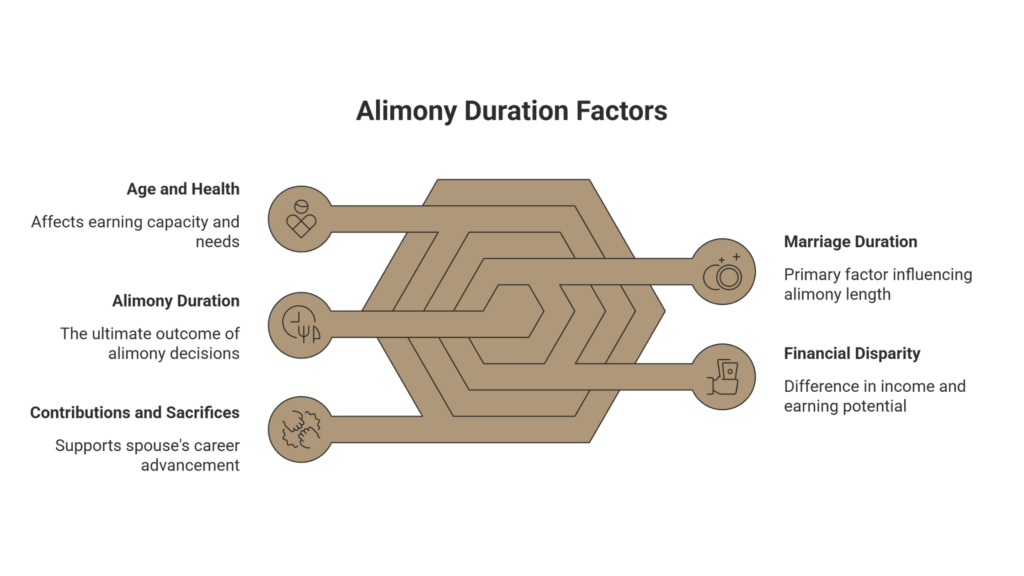
What Determines How Long Alimony Lasts
Courts consider multiple factors when determining alimony duration, though the weight given to each varies by jurisdiction. The length of your marriage carries the most influence in most states, but judges also examine the financial disparity between spouses, including income levels, earning potential, and the standard of living you maintained during marriage. Age and health of both spouses affect duration assessments, particularly when older age or health conditions limit earning capacity. Contributions made during marriage (including career sacrifices that supported a spouse’s education or advancement) factor into duration decisions as courts attempt to balance fairness with encouraging financial independence.
These factors interact rather than standing alone. A 15-year marriage where one spouse sacrificed career advancement to raise children creates different duration considerations than a 15-year marriage where both spouses maintained similar earning trajectories. Family law attorneys emphasize that courts weigh financial needs and post-divorce budgets to ensure sustainability, assessing both parties’ documented income, expenses, housing, healthcare, and retirement goals rather than applying formulas mechanically.
Marriage Duration as the Primary Factor
Length of marriage significantly influences alimony duration nationwide, with most states using marriage length as the foundation for duration calculations. Short marriages under five years typically result in minimal or no alimony, as courts presume both spouses can return to their pre-marriage financial situations relatively quickly. Medium-length marriages between five and ten years often see support lasting several years, providing time for career reentry or skill development. Long-term marriages exceeding 20 years may warrant extended or permanent support when one spouse can’t reasonably achieve financial independence.
The marriage duration calculation typically runs from your wedding date to the divorce filing date rather than finalization. This distinction matters in lengthy divorce proceedings, as additional years may affect duration calculations depending on your state.
Additional Circumstances That Affect Duration
Beyond marriage length, courts evaluate circumstances that affect each spouse’s financial capacity. Your ability to become self-supporting influences duration significantly, with judges considering education level, job history, employment gaps, and current market conditions for your skills. The presence of children affects duration when childcare responsibilities limit earning capacity, particularly for primary custodial parents of young children. Courts also examine whether you made sacrifices that advanced your spouse’s career, such as relocating for job opportunities, supporting them through advanced degrees, or managing household responsibilities while they built professional credentials.
Standard of living during marriage creates expectations courts try to maintain when feasible. If you enjoyed substantial income during a long marriage, courts may extend alimony duration to provide time for adjusting to reduced circumstances rather than expecting immediate adaptation to dramatically lower income levels.
Real-World Duration Examples: How Courts Apply These Factors
Understanding how duration factors combine in actual cases provides clearer expectations than abstract rules. These recent cases show how marriage length interacts with other circumstances to produce specific outcomes.
Massachusetts: Mental Health Condition Doesn’t Override Duration Limits
In S.S. v. S.S., an approximately 8-year marriage ended with the wife, then 40-41 years old, experiencing significant mental health issues preventing current employment. The trial court initially awarded general term alimony potentially lasting until death, remarriage, or court order, deviating from Massachusetts’ presumptive 97-month limit due to her condition. The Appeals Court vacated this, mandating termination after approximately 8 years. The court ruled deviation unwarranted because the wife failed to prove by preponderance of evidence that her condition would persist beyond the presumptive term. This case demonstrates that health conditions alone don’t automatically justify exceeding state duration limits without clear evidence the condition will continue long-term.
New Jersey: Reforms Cap Duration Below Marriage Length
Under New Jersey’s post-2014 reformed law, a 12-year marriage resulted in limited durational alimony of $80,000 annually for 8 years rather than the full 12-year cap. The court weighed economic dependency factors but limited duration to 8 years, finding circumstances didn’t qualify as “exceptional” under reformed standards. The payer’s retirement considerations and recipient’s realistic capacity to rebuild earning potential influenced the below-cap award. This illustrates how courts balance statutory caps against practical assessments of self-sufficiency timelines, even in reformed states with clearer formulas.
California: High-Income Disparity in Short Marriage
Kelly Clarkson’s approximately 7-year marriage to Brandon Blackstock resulted in $115,000 monthly spousal support. California courts for marriages under 10 years presume approximately half-length duration, suggesting 3.5 years here, though the final duration wasn’t specified in available records. The substantial amount reflected extreme earning capacity disparity despite the short marriage, with high monthly payments potentially compensating for abbreviated duration. This case shows how courts balance duration and amount, potentially awarding higher payments when limiting duration based on marriage length.
Common Duration Challenges
Recipients often underestimate the time required for credential updating and career reentry. Plan for 6-12 months beyond degree completion for job searching and initial lower-level reentry positions rather than assuming immediate full income replacement. Market conditions and employment gaps create realistic delays that courts sometimes recognize when evaluating whether to extend rehabilitative alimony beyond initial awards.

How Marriage Length Affects Alimony Duration
State approaches to correlating marriage length with alimony duration vary, but patterns emerge across jurisdictions. Florida’s statutory framework provides the clearest example of duration tied directly to marriage length, while other states rely on judicial discretion guided by informal benchmarks. Your marriage length category determines the baseline expectation for support duration in most jurisdictions, which courts then adjust based on factors like earning capacity disparities, health considerations, and contributions made during marriage.
Marriage Length | Typical Alimony Duration | How Courts Generally View It |
Under 5 years | Minimal or none | Courts expect rapid financial independence |
5–10 years | 2–5 years (rehabilitative) | Time-limited support for reentry or retraining |
10–20 years | Up to ~50–60% of marriage length | Greater interdependence, longer transition |
Over 20 years | Extended duration possible | Support may continue when self-sufficiency is unrealistic |
Short-Term Marriages (Under 5 Years)
Short-term marriages rarely result in significant alimony obligations. Florida caps durational alimony at 50% of marriage length for unions under ten years, with no durational alimony available for marriages under three years. Illinois guidelines suggest approximately 20% of marriage length for 5-year marriages, resulting in roughly one year of support.
Medium-Length Marriages (5-10 Years)
Marriages between five and ten years typically result in rehabilitative alimony lasting several years. Florida maintains the 50% cap, meaning a seven-year marriage results in maximum durational alimony of 3.5 years. California’s informal guideline of half the marriage length would suggest 2.5 to 5 years for marriages in this range. These durations acknowledge that moderate-length marriages create some financial interdependence requiring support, but not permanent dependency.
Long-Term Marriages (10-20 Years)
Long-term marriages see substantially longer alimony durations, often approaching or exceeding half the marriage length. Florida increases the cap to 60% of marriage length for moderate-term marriages of ten to twenty years, meaning a 15-year marriage could result in up to nine years of durational alimony. Illinois suggests approximately 60% of marriage length for 15-year marriages.
Marriages Over 20 Years
Marriages exceeding 20 years may warrant extended alimony arrangements, particularly when one spouse’s age or health conditions make achieving financial independence unlikely. Florida caps durational alimony at 75% of marriage length for long-term marriages over 20 years, allowing up to 18.75 years of support for a 25-year marriage. States like California and DC may still award permanent alimony for very long marriages when circumstances warrant, though courts increasingly favor durational awards with extended timeframes over truly permanent obligations.
Types of Alimony and Their Duration Differences
The type of alimony awarded determines its duration framework as much as marriage length. Rehabilitative alimony now dominates awards, reflecting judicial preference for supporting self-sufficiency over long-term dependency.
Temporary Alimony (Pendente Lite) provides financial support during divorce proceedings, ending automatically when the court issues the final divorce decree. Duration depends entirely on how long your divorce takes to finalize.
Rehabilitative Alimony supports recipients while they work toward financial independence through education, training, or career reentry. This type typically lasts two to five years, though specific duration depends on the training plan proposed and approved by the court. Florida caps rehabilitative alimony at five years maximum, requiring a specific plan showing how the recipient will achieve self-support.
Permanent Alimony has become increasingly rare as states reform alimony laws to emphasize self-sufficiency. Florida eliminated permanent alimony effective July 1, 2023, for all cases filed or pending after that date. States like California and New York still permit permanent alimony for very long marriages when recipients can’t reasonably achieve self-sufficiency due to age, health, or limited career prospects.
Reimbursement Alimony compensates spouses who supported their partner through education or career advancement. Duration ties directly to the support provided rather than marriage length, typically lasting until the supporting spouse recovers a predetermined amount.
How State Laws Impact Alimony Duration
State-specific laws create dramatic variation in how long alimony lasts for similar circumstances. Some states employ mathematical formulas tying duration directly to marriage length, while others grant judges broad discretion to consider individual factors.
States With Formula-Based Duration Guidelines
Florida stands alone among U.S. states in providing specific statutory formulas for alimony duration as of 2026. The state’s reforms establish maximum durations as percentages of marriage length: 50% for short-term marriages under ten years, 60% for moderate-term marriages of ten to twenty years, and 75% for long-term marriages exceeding twenty years.
Other states use informal formulas without statutory mandate. Illinois employs multipliers correlating marriage length to duration percentages, providing structured approaches that create consistency while preserving judicial flexibility for unusual situations.
States With Judicial Discretion Approaches
Most states grant judges substantial discretion to determine alimony duration based on statutory factors rather than formulas. California presumes half the marriage length for marriages under ten years but allows judges to deviate based on circumstances, with marriages over ten years receiving no presumptive duration cap. This flexibility benefits cases with unusual circumstances but creates less predictability when planning.
States That Have Eliminated Permanent Alimony
Florida represents the only state clearly confirmed to have eliminated permanent alimony by 2026, enacting reforms effective July 1, 2023, that prohibit lifelong support in all new or pending cases. Florida’s elimination of permanent alimony also established retirement as explicit grounds for modification, allowing paying spouses to seek reductions or termination upon retirement with six months advance notice.
When Alimony Payments End Before the Scheduled Date
Alimony obligations can terminate earlier than originally scheduled when specific events occur or circumstances change substantially. Courts generally require formal modification orders to change alimony obligations, meaning payments continue until judges officially terminate them.
Remarriage or Cohabitation terminates support obligations in most states automatically upon remarriage. Cohabitation in a marriage-like relationship may also reduce or terminate alimony, though this requires court action and proving the relationship provides substantial financial support similar to marriage.
Death of Either Party terminates alimony obligations automatically by operation of law in most jurisdictions. Courts may require paying spouses to maintain life insurance naming their ex-spouse as beneficiary to provide security if the paying spouse dies while alimony obligations remain.
Retirement of the Paying Spouse increasingly serves as grounds for modifying or terminating alimony, particularly after Florida’s 2023 reforms explicitly recognized retirement as a basis for modification. Courts evaluate whether retirement occurs at a reasonable age and in good faith rather than primarily to avoid alimony obligations.
Court-Ordered Modifications occur when either party demonstrates substantial, unforeseeable changes in circumstances that make the original arrangement unfair or impractical. Qualifying changes typically include involuntary job loss or significant income reductions for paying spouses, substantial income increases for recipients, serious health issues affecting either party’s financial capacity, or recipients’ failure to pursue self-sufficiency as intended.

Understanding Duration vs. Amount Trade-offs: Strategic Considerations
Negotiating alimony requires balancing duration against monthly payment amounts, with different structures serving distinct financial goals. Family law attorneys emphasize strategic trade-offs through comprehensive financial analysis, tax implications, and flexibility for life changes rather than focusing solely on total dollar amounts.
When Shorter Duration With Higher Amounts Makes Sense
Higher monthly payments for shorter duration often provides better total value when you can realistically achieve 70% or more of needed income within 3-4 years. This structure benefits recipients who need intensive support during credential updating or career reestablishment but can become self-sufficient relatively quickly. Paying spouses with current high income but uncertain future earnings may prefer this arrangement, capping total exposure while acknowledging current capacity to pay. Negotiating $5,000 monthly for 3 years provides $180,000 total support, potentially preferable to $3,000 monthly for 6 years totaling the same amount if the recipient can achieve independence faster.
When Longer Duration With Lower Amounts Works Better
Extended lower payments suit recipients needing sustained transition time who can’t realistically compress career rebuilding into short timeframes. Older recipients, those with significant employment gaps, or individuals in fields requiring extensive retraining benefit from longer horizons that reduce monthly pressure to achieve full income replacement. Paying spouses with stable long-term income but current cash flow constraints may prefer spreading obligations over extended periods. This structure reduces month-to-month financial strain while providing predictable, manageable payments.
Lump-Sum Buyouts vs. Periodic Payments
Lump-sum buyouts eliminate future modification risk and provide clean breaks, making financial sense for payers with sufficient assets or cash flow who want to cap liability and avoid ongoing taxable income issues. Recipients benefit if they can invest the sum effectively or prefer asset control over uncertain payment streams that risk payer default or court challenges. Calculate present value using discounted cash flow, applying appropriate discount rates to future payment streams. While specific formulas vary, family law guidance stresses consulting financial experts for present value analysis that accounts for inflation, investment return potential, and risk factors. A $10,000 annual payment stream for 10 years might have present value around $85,000-$90,000 depending on discount rates applied.
Periodic payments suit recipients needing steady income for essentials who lack confidence in managing lump sums or achieving adequate investment returns. This structure maintains ongoing financial connection but exposes both parties to modification disputes and enforcement challenges if payers default.
Tax Implications Post-TCJA
Attorneys note that while alimony payments aren’t deductible for payers or taxable for recipients in post-2018 divorces, this reality impacts property division negotiations. Payers may prefer trading higher asset shares for lower or shorter alimony since payments provide no tax benefit. Recipients might accept longer duration with lower monthly amounts in exchange for keeping more marital assets, since the support isn’t taxable income anyway.
Common Strategic Mistakes
Attorneys identify inadequate preparation as a critical error: negotiating without full financial documentation or expert input weakens positions and misses tax and asset trade-off opportunities. Overlooking future change clauses leads to costly litigation if circumstances shift, such as retirement or health issues. Emotional rigidity prevents compromise on duration and amount structures, prolonging disputes rather than reaching fair, enforceable agreements based on financial realism.
3 Financial Mistakes People Make During Alimony Decisions
Understanding common pitfalls helps you avoid decisions that feel expedient but create long-term financial instability.
Accepting duration without modeling actual financial impact: Many people negotiate alimony duration abstractly without calculating whether the proposed timeline actually allows achieving financial stability. Create detailed budgets showing income needs, factor in realistic job search timelines or education completion, and verify that proposed duration provides adequate runway for securing sustainable employment.
Overestimating ability to quickly achieve pre-marriage income levels: Career gaps create genuine reentry challenges that many recipients underestimate when accepting shorter duration. Research current market conditions for your field, account for potential credential updating, and honestly assess how long establishing adequate income will realistically take rather than optimistic assumptions.
Ignoring tax implications of different duration structures: Alimony taxation rules affect net value of different duration and payment amount combinations. Work with tax professionals and financial advisors who understand divorce-specific tax considerations before finalizing agreements, as decisions you make during divorce negotiations carry long-term consequences that are difficult or impossible to reverse.
Conclusion
Understanding how long alimony lasts in 2026 requires examining the interaction between marriage length, alimony type, and state-specific laws rather than relying on simplified rules of thumb. Duration ranges from months for short marriages to potentially decades for very long marriages, with rehabilitative alimony now dominating awards and emphasizing paths to self-sufficiency over permanent dependency. State reforms continue shifting away from lifetime obligations toward time-limited support, with Florida leading by eliminating permanent alimony and establishing clear percentage caps tied to marriage duration.
Marriage length serves as the primary factor, but age, health, earning capacity, standard of living during marriage, and contributions made all influence whether duration falls toward the shorter or longer end of typical ranges. Recent case law demonstrates that courts apply duration limits even when recipients face challenges like health conditions, requiring clear evidence that circumstances will persist beyond presumptive terms. Strategic negotiation balances duration against payment amounts, considering factors like present value calculations, lump-sum buyout alternatives, and tax implications rather than accepting first proposals.
When the decisions are permanent, clarity matters more than speed. Even Path provides fiduciary-first financial guidance specifically designed for the emotionally complex financial transitions that accompany divorce. Their trauma-informed approach combines Certified Divorce Financial Analyst expertise with practical support for implementing sustainable financial plans rather than pushing quick resolutions that might not serve your long-term interests. Whether you’re evaluating proposed alimony terms during mediation or considering modifications years after divorce, professional guidance helps you understand what realistic timelines for achieving financial independence actually require.
Ready to gain clarity about how alimony duration decisions affect your financial future? Schedule a consultation to discuss your specific situation with professionals who understand both the legal frameworks and the practical realities of rebuilding financial stability after divorce.