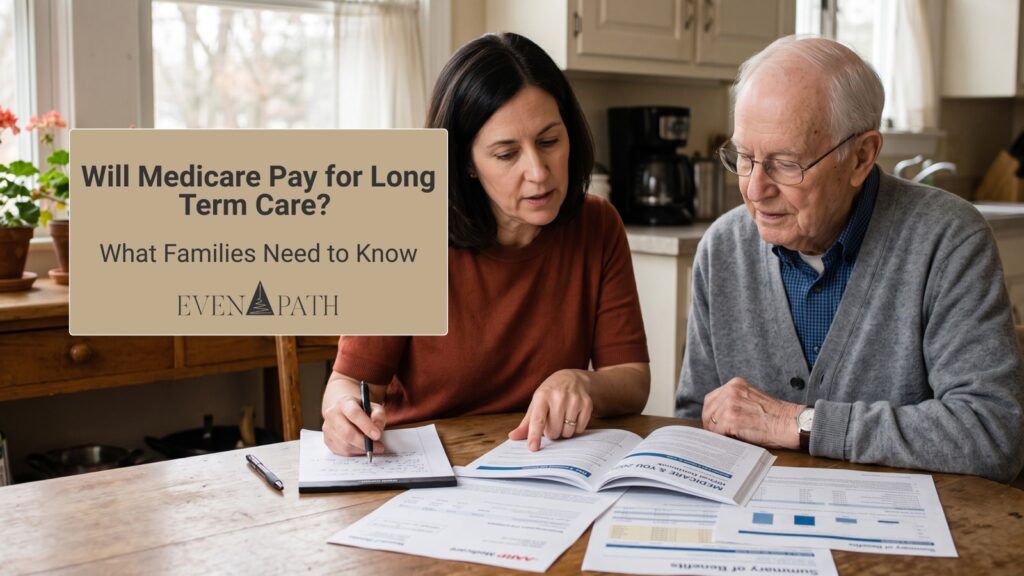
The question of whether Medicare will pay for long term care has a short and surprising answer for most families: mostly no. Medicare is health insurance built for acute medical needs, not for the ongoing daily help that long term care provides. That single distinction catches countless families off guard, often at the worst possible moment, when a parent suddenly needs more help than anyone expected. Understanding the gap now, before a crisis, lets you plan instead of scramble. At Even Path, we help families map out who pays for what, long before the need arrives. Our senior care planning service exists to turn this confusing question into a clear plan.
Worried about how your family would cover long term care?
The Even Path team helps you understand the gaps and build a plan before a crisis forces the decision. → Schedule a planning conversation
TL;DR: Will Medicare Pay for Long Term Care?
Medicare will not pay for most long term care, because it does not cover custodial care, the daily help with bathing, dressing, and eating that defines long term care. The one exception is short-term skilled care. After a qualifying three-day hospital stay, Medicare covers up to 100 days in a skilled nursing facility, with full coverage for the first 20 days and a daily copay after that. Once skilled care is no longer needed, or after 100 days, Medicare coverage ends. Medicare also covers skilled home health and hospice. For true long term care, families turn to Medicaid, long term care insurance, veterans benefits, or personal savings. The earlier you understand this gap, the more options you have to plan for it.
Key Points
Medicare does not cover custodial care. The daily, non-medical help that makes up most long term care falls outside Medicare entirely.
The one exception is short and skilled. Medicare covers up to 100 days of skilled nursing care after a qualifying hospital stay, not indefinite care.
A copay kicks in after 20 days. In 2026, days 21 to 100 in a skilled nursing facility carry a daily coinsurance of $217.
Observation status is a trap. A hospital stay must be a formal inpatient admission of three days to unlock skilled nursing coverage.
Medicaid is the real long term care payer. Unlike Medicare, Medicaid covers ongoing custodial care for those who qualify financially.
Costs are substantial. A semi-private nursing home room runs well over $9,000 a month nationally, and most people will need some care.
Other options exist. Long term care insurance, hybrid policies, and veterans benefits can all help fill the gap Medicare leaves.
Even Path plans for the gap. We help families build a funding strategy before a crisis removes the easy choices.

The Short Answer: Will Medicare Pay for Long Term Care?
For most situations, the answer is no. To understand why, you have to understand how Medicare defines care, because the program draws a sharp line that families rarely see coming.
Skilled Care Versus Custodial Care
Medicare divides care into two categories. Skilled care is medical: wound care, physical therapy, intravenous medication, the kind of treatment that requires a licensed professional. Custodial care is non-medical: help with bathing, dressing, eating, and moving around. Long term care is overwhelmingly custodial, and that is exactly what Medicare does not cover.
The Medicare.gov long term care page states plainly that Medicare does not pay for most long term care, including help with daily activities. This is not a loophole or a technicality. It is the fundamental design of the program. Medicare exists to treat illness and injury, not to fund years of daily assistance.
Why This Surprises So Many Families
Most people assume that the insurance they paid into for decades will cover them when they need help aging. That assumption feels reasonable, yet it does not match how Medicare works. As a result, families often discover the gap during a hospital discharge, when a social worker explains that Medicare will not pay for the assisted living or in-home aide their parent now needs.
This moment is jarring, but it is far better to learn it in advance. When you understand the limits early, you can build a plan. When you learn them in crisis, you are forced to make rushed and expensive choices.
The One Exception: Skilled Nursing Care for Up to 100 Days
There is a single meaningful exception to the rule, and it causes plenty of confusion on its own. Medicare does cover a short stretch of skilled nursing facility care, but the conditions are strict and the coverage is temporary.
The Three-Day Rule
To unlock skilled nursing coverage, you generally need a qualifying inpatient hospital stay of at least three days. According to Medicare.gov, this admission must be a formal inpatient stay, and that detail trips up many families. A person can spend days in a hospital bed under observation status without being formally admitted, which does not count toward the three-day requirement.
Because of this, it is worth asking directly whether a hospital stay is inpatient or observation. The distinction has thousands of dollars riding on it. Hospitals are required to notify patients of their status, but the notice is easy to miss in the chaos of a medical event. If a parent is admitted, ask the care team to confirm the status in writing, and ask again if it changes during the stay. A day spent under observation can quietly disqualify the skilled nursing coverage a family is counting on.
What the Coverage Actually Pays
When you qualify, Medicare covers skilled nursing facility care on a sliding scale within each benefit period. The numbers below show exactly how the coverage and costs break down across the 100 days.
Medicare covers short, skilled recovery. It does not fund the daily, ongoing care that long term care really means.
After the first 20 days, a daily copay applies. In 2026, that coinsurance is $217 per day for days 21 through 100, which adds up to more than $17,000 if a stay runs the full length. After day 100, or once a person no longer needs daily skilled care, Medicare coverage stops entirely. A benefit period resets only after 60 consecutive days without inpatient or skilled care.
What Medicare Does Not Cover
The list of what Medicare leaves out is long, and it includes nearly everything most families picture when they think of long term care. Knowing these gaps is the first step to planning around them.
Custodial and Personal Care
Medicare does not pay for help with the activities of daily living when that help is the only care needed. A home aide who assists a parent with bathing and meals is not covered. Neither is the personal care provided in most assisted living settings. Because this kind of support is what most aging adults need, the gap is enormous. The National Council on Aging underscores the same point, noting that even the covered skilled stay is rarely free once the daily copays begin.
This is the heart of the confusion. The care families worry about most, the steady daily help that lets a parent stay safe at home or in a community, is precisely the care Medicare was never built to fund. Recognizing that early changes how you prepare.

Assisted Living and Long-Term Nursing Home Stays
Room and board in an assisted living community falls entirely outside Medicare. A permanent nursing home stay, once skilled care is no longer the reason for it, is also not covered. Families who assumed Medicare would step in are often stunned by the monthly cost they must cover themselves. Our guide on what to do when an elderly parent has no money walks through the options when savings cannot stretch to cover these bills.
The Coverage That Does Exist
To be fair, Medicare does cover some valuable services. It pays for skilled home health care when a doctor orders it and the care is intermittent rather than full-time. It covers hospice care for those who are terminally ill, often at little cost. The National Institute on Aging offers a clear overview of where these lines fall. These benefits matter, but they are narrow, and none of them solves the central problem of ongoing daily care.
The Real Cost of Long Term Care
To understand why this gap matters so much, you have to look at the numbers. Long term care is one of the largest financial risks a retiree faces, and most people underestimate it.
How Much It Costs
Long term care is expensive and getting more so. According to CareScout’s Cost of Care data, a semi-private room in a nursing home runs a national median well over $9,000 per month, and a private room costs more. Assisted living averages around $6,200 per month. In-home care, charged by the hour, can rival those figures for someone who needs many hours of help each day. These costs have climbed faster than general inflation for years. Spread over a multi-year need, the total can reach several hundred thousand dollars, which is enough to reshape even a well-funded retirement.
How Likely You Are to Need It
The risk is not rare. Research summarized by the Administration for Community Living finds that most people turning 65 will need some form of long term care during their lives, and a meaningful share will need it for several years. Women tend to need care longer than men, in part because they live longer. These are not edge cases. They are the statistical center of aging in America.
Why Medicare Cannot Fill This Role
Medicare was never designed to absorb a cost of this size and duration. A program that paid for years of custodial care for every beneficiary would face overwhelming expense. That is why the system relies on a different program, Medicaid, to serve as the long term care safety net, and why private planning matters so much for everyone in between.
Not sure how your family would absorb these costs?
Even Path models the real numbers and builds a funding plan that fits your situation. → Run the numbers with us

Who Pays When Medicare Stops
If Medicare covers so little, the natural question is who covers the rest. Several sources can fill the gap, and most families end up combining more than one.
Medicaid: The Primary Long Term Care Payer
Medicaid, unlike Medicare, does cover long-term custodial care, including nursing home care and many home-based services. The catch is that Medicaid is means-tested. A person generally must have very limited income and assets, often around $4,000 in countable resources, to qualify. The Medicaid.gov long-term services page explains how states administer this coverage. Many families reach Medicaid only after spending down their savings on care.
Long Term Care Insurance and Hybrid Policies
Long term care insurance is designed specifically for this gap. A policy can pay a daily or monthly benefit toward care, sparing your savings. Newer hybrid policies combine life insurance or an annuity with a long term care benefit, which addresses the old worry of paying premiums for coverage you might never use. These policies work best when purchased earlier, while you are still healthy enough to qualify and premiums are lower.
Veterans Benefits and Personal Savings
Veterans and their surviving spouses may qualify for the VA Aid and Attendance benefit, which helps cover care costs. The VA pension and Aid and Attendance page explains eligibility. Beyond these programs, many families simply pay out of pocket from savings, investments, or home equity. One often-missed detail is that some long term care costs can qualify as deductible medical expenses, and the IRS outlines the rules in Publication 502. Our guide on working with a financial advisor for elderly parents covers how to coordinate these sources without draining a retirement.
Most families end up weaving several of these threads together. A parent might use savings first, then a long term care policy, then Medicaid once resources run low. Coordinating that sequence well can mean the difference between protecting an inheritance and spending every dollar on care. A retirement planning worksheet can help you map the resources you have before you decide how to deploy them.
5 Things to Know Before You Need Long Term Care
A little knowledge now prevents a great deal of stress later. These five points capture what every family should understand in advance.
Medicare is not your long term care plan. It covers short, skilled recovery, not ongoing daily care. Build a separate plan for the care Medicare will not fund.
The three-day inpatient rule is real. Confirm whether a hospital stay is inpatient or observation, because only a formal admission unlocks skilled nursing coverage.
The 100-day clock runs out fast. Even the covered skilled stay ends at 100 days, and a copay applies after day 20. Know where the cliff is.
Medicaid requires spending down first. It is the main long term care payer, but only after assets fall to strict limits. Plan early if you want to protect any savings.
Insurance is cheaper when you are healthy. Long term care and hybrid policies cost less and are easier to qualify for years before you need them. Waiting narrows your options.
Understanding these five points turns a frightening unknown into a set of manageable decisions you can make on your own timeline.

How to Plan for the Gap Medicare Leaves
The purpose of understanding this gap is not to worry you. It is to give you time, because time is the single biggest advantage in planning for long term care.
Start the Conversation Early
The best time to plan is well before care is needed. Talking with aging parents about their wishes, their resources, and their coverage opens the door to real options. Once a health crisis hits, those options narrow quickly. A calm conversation at the kitchen table beats an urgent one in a hospital hallway every time.
Match the Strategy to the Situation
There is no single right answer. A family with substantial savings might self-fund and protect a portion through insurance. Those with modest means might focus on understanding Medicaid eligibility in advance. Veterans and their families should explore VA benefits. The right mix depends entirely on your numbers, your health, and your goals, which is why a personalized plan beats a generic rule of thumb.
Where a Fiduciary Advisor Fits
This is the kind of planning a fee-only fiduciary handles well, because it touches income, taxes, insurance, and estate questions all at once. A fiduciary has no product to sell and no commission to chase, so the recommendation serves you rather than a sales goal. At Even Path, founded by Josh Dunlop, CFP and CDFA, we help families turn the Medicare gap from a source of fear into a line item with a plan behind it. The goal is never to alarm you. It is to make sure that when care becomes necessary, the money to pay for it is already accounted for.
Conclusion
So, will Medicare pay for long term care? For the daily, ongoing help that most aging adults eventually need, the answer is no. Medicare covers short, skilled recovery after a hospital stay, along with home health and hospice, but it was never built to fund years of custodial care. That gap is one of the most consequential surprises in retirement, and far too many families discover it during a crisis.
The encouraging news is that this gap is entirely plannable. Medicaid, long term care insurance, veterans benefits, and personal savings can each play a role, and the earlier you understand your options, the more of them remain open. Knowledge here is not a burden. It is the very thing that lets you choose calmly instead of reacting under pressure.
Even Path was built to help families navigate exactly this question. We translate the confusing rules into clear numbers, weigh the funding options against your real situation, and build a plan you can rely on. There is no product to sell and no fear to stoke. There is only a steady, honest look at how to protect both your care and your savings.
Turn the Medicare gap into a plan, not a worry.
Work with the Even Path team to build a long term care funding strategy before you need it. → Schedule a planning conversation