
Pre Retirement Anxiety: 7 Proven Ways to Feel Confident
Pre retirement anxiety affects more people than you might think, and it’s rooted in something real. The financial landscape keeps shifting. Your identity feels tangled with your career. The future seems uncertain in ways that keep you awake at night. These feelings don’t mean you’re unprepared or making a mistake. They mean you’re approaching one of life’s most significant transitions with the seriousness it deserves.
Nearly half of Americans report feeling more stressed heading into 2026 than the prior year. For those nearing retirement, the pressure intensifies. Recent data shows 27% of Americans have decreased confidence in meeting retirement goals compared to the previous year. Among Gen X, the generation closest to retirement, that number jumps to 38%.
When you can’t undo these choices, clarity matters more than speed. Working with a fiduciary financial advisor who prioritizes helping you think clearly before acting creates a more supportive environment than product-driven sales approaches.
TL;DR: Pre Retirement Anxiety
Pre retirement anxiety stems from financial uncertainty, identity shifts, and concerns about purpose after leaving work. Address these worries systematically by building a detailed financial plan that accounts for worst-case scenarios with specific contingency calculations, defining what fulfillment looks like beyond your career, and testing your retirement lifestyle for 3-12 months before committing fully. Strengthen social connections, create daily structure, confront specific fears with quantified fallback plans, and seek expert guidance from fiduciary advisors or retirement coaches. The goal isn’t eliminating all uncertainty but gaining enough clarity to make sound decisions.
Key Points: What You Need to Know About Pre-Retirement Anxiety
- Financial fears dominate but often overestimate risk: 46% of older adults worry about insufficient savings, yet proper contingency planning reveals many scenarios are manageable with specific adjustments.
- Identity loss creates real emotional challenges: Separating your self-worth from your work title requires intentional effort before you retire, not after.
- Healthcare costs need early attention: Medicare Part B premiums exceed $200 monthly in 2026, with median out-of-pocket maximums reaching $5,900 for Medicare Advantage plans.
- Social isolation accelerates post-retirement: 20-25% of community-dwelling older adults experience social isolation, with serious health consequences including increased mortality risk.
- Testing retirement for 3-12 months reduces anxiety: 60-75% of trial participants identify spending gaps and adjust plans, leading to 15% higher confidence.
- Structure matters more than you think: Creating a flexible weekly framework maintains purpose and prevents the aimlessness that often leads to retirement boredom depression.
- Professional guidance serves different needs: Financial advisors handle money and tradeoffs, retirement coaches address identity and purpose, and therapists support mental health during major transitions.
Table of Contents
Toggle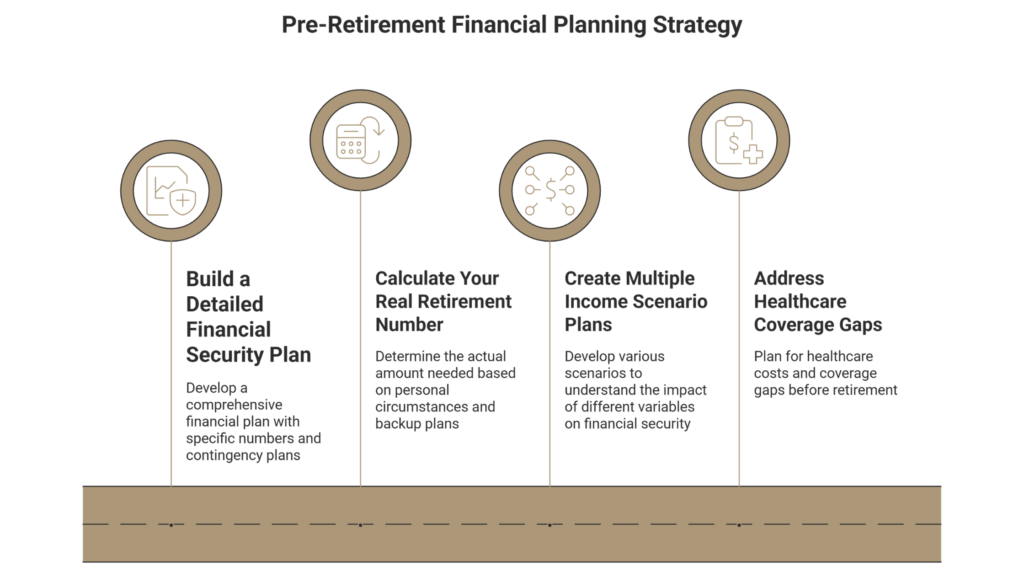
Understanding Pre-Retirement Anxiety: Why You’re Not Alone
The transition to retirement represents more than leaving a job. You’re stepping away from a structure that’s defined your days, your identity, and your social connections for decades. The anxiety you feel isn’t irrational. It’s a natural response to facing unknowns that will permanently shape the next chapter of your life.
Recent research confirms your experience is widespread. 48% of Americans report increased stress heading into 2026, with day-to-day expenses, inadequate emergency savings, and low income topping the list of concerns. For professionals approaching retirement, these worries intensify because the safety net of a steady paycheck is about to disappear.
What Pre-Retirement Anxiety Looks Like
Retirement worries manifest differently for everyone, but common patterns emerge. You might find yourself calculating and recalculating your savings, wondering if the numbers will hold up under real-world conditions. Sleep becomes elusive as questions cycle through your mind: What if healthcare costs exceed projections? What will I do with my time? Who am I without my career title?
Physical symptoms often accompany the emotional strain. Changes in appetite, difficulty concentrating, or a general sense of unease about the future signal that your body recognizes the magnitude of this transition. 43% of pre-retirees worry specifically about having enough money to support themselves or their families in retirement.
Why This Transition Triggers Worry
Retirement triggers anxiety because it forces you to confront multiple unknowns simultaneously. Financial security tops the list. 62% of pre-retirees express uncertainty about whether their savings will last their lifetime. Unlike other financial decisions, you can’t easily reverse course if you miscalculate.
Source of Anxiety | What’s Really Behind It | Practical Way the Article Addresses It |
Fear of running out of money | Uncertainty, not lack of resources | Stress-tested financial planning and contingency modeling |
Loss of identity | Work-defined self-worth | Purpose planning beyond career roles |
Healthcare uncertainty | Unknown future costs | Early Medicare planning and cost projections |
Social isolation | Loss of daily work connections | Intentional relationship-building before retirement |
Lack of structure | Too much unstructured time | Flexible weekly routines and trial retirement periods |
Identity shifts create another layer of complexity. For many professionals, work provides more than income. It offers purpose, social connection, and a clear answer to “What do you do?” Losing that framework can feel like losing part of yourself.
Healthcare concerns add practical urgency. Medicare coverage begins at 65, but understanding what it covers requires research. 3.5 million traditional Medicare beneficiaries lack supplemental coverage, exposing them to a $1,736 hospital deductible and 20% coinsurance in 2026.
Social isolation poses risks many people underestimate before retiring. Work provides built-in social interaction. Without that daily contact, building and maintaining connections requires intentional effort. Research shows increased social isolation over time significantly raises mortality risk and contributes to cognitive decline.
Strategy 1: Build a Detailed Financial Security Plan
Financial uncertainty drives much of pre-retirement anxiety, but vague worry helps no one. You need specific numbers, realistic scenarios, and clear contingency plans. This doesn’t mean creating a perfect forecast. It means understanding your financial reality well enough to make informed tradeoffs and know exactly how you’d respond if markets underperform or expenses exceed projections.
Start by working with a fiduciary financial advisor who isn’t compensated through product sales. When advisors earn commissions on investments or insurance products they recommend, their guidance inevitably carries conflicts of interest. Fee-only advisors provide unbiased analysis during major life transitions.
Calculate Your Real Retirement Number With Contingency Buffers
Your retirement number isn’t a single figure pulled from generic rules of thumb. It’s the amount you need based on your specific circumstances, spending patterns, and backup plans. 62% of CFP professionals recommend developing or revising a comprehensive financial plan as a top 2026 priority.
Calculate your baseline expenses first: housing, food, utilities, insurance, transportation. Then add discretionary spending for travel, hobbies, and lifestyle choices. Factor in healthcare costs, which often exceed initial estimates. Don’t forget taxes on required minimum distributions from traditional retirement accounts.
Compare these expenses against your income sources: Social Security, pensions if applicable, and withdrawals from retirement accounts. But don’t stop there. Work with an advisor to stress-test your plan using Monte Carlo simulations that model 1,000+ market scenarios over 30-35 years. Track your portfolio survival rate and sustainable withdrawal percentages across different conditions.
Here’s what contingency planning looks like with actual numbers. If you have a $1 million portfolio and need $40,000 annually (4% withdrawal rate), calculate what happens if markets drop 20% in year one. The answer: reduce your withdrawal to 3% ($30,000) and tap an emergency fund covering 2-3 years ($60,000-$90,000 in cash equivalents) to avoid selling assets at a loss. This specific adjustment lets you maintain spending power while your portfolio recovers.
For longevity risk, calculate your “floor” income from guaranteed sources. If Social Security and any pension cover $3,200 of your $4,800 monthly needs, you only need portfolio withdrawals for $1,600 monthly ($19,200 annually). At a 4% withdrawal rate, that requires $480,000, not the full amount you might have assumed necessary. Understanding this distinction reduces anxiety about outliving savings.
Create Multiple Income Scenario Plans
Single-point projections mislead more than they inform. Markets fluctuate. Healthcare needs change. Spending patterns evolve. Creating multiple scenarios helps you understand how different variables affect your financial security.
Develop a baseline scenario using moderate assumptions about investment returns, inflation, and spending. Then create pessimistic versions. What happens if markets underperform for the first five years? Can your plan withstand a spouse needing long-term care?
69% of CFP professionals urge tax optimization focus for 2026, recognizing that tax law changes significantly impact retirement income. Consider strategies like Roth conversions before retirement, when you can potentially convert funds at lower tax brackets. These tactics require planning while you’re still working.
For market crash scenarios, implement time-segmented portfolios that divide assets by horizon. For a $1.2 million portfolio, structure it this way: short-term bucket (cash/bonds for 3-5 years’ expenses), medium-term (balanced allocation for years 6-10), long-term (equities for year 11+). If markets drop 30%, shift from 60/40 stocks/bonds to 40/60 while reducing annual spending by 20-25% (from $48,000 to $36,000-$38,400). Draw only from your bonds/cash bucket while equities recover. Historical backtesting shows portfolios typically recover within five years using this approach.
Address Healthcare Coverage Gaps With Specific Cost Projections
Medicare provides essential coverage but leaves significant gaps. Understanding these limitations before you retire prevents costly surprises later. Traditional Medicare covers hospital stays and doctor visits but lacks prescription drug coverage unless you add Part D. It also doesn’t cover dental, vision, or hearing services.
Compare Medicare Advantage plans against traditional Medicare with supplemental coverage. Each approach involves tradeoffs. Medicare Advantage often includes prescription drug coverage and may offer additional benefits like dental or gym memberships. However, these plans typically require using network providers.
For long-term care planning, forecast expenses using 5-7% annual inflation on base healthcare costs. If you’re spending $15,000 annually at 65, potential long-term care needs at 80 could reach $300,000 as a lump sum or $8,000 monthly for three years. This projection might prompt reallocating 10-15% of your portfolio to annuities or hybrids, plus cutting essential expenses by 15% (total spending from $60,000 to $51,000 annually) if care becomes necessary. 83% of advised clients have steps addressing outliving savings including healthcare, versus 53% without advisors.
Research coverage options months before your 65th birthday. Missing initial enrollment periods can result in permanent premium penalties. If you’re retiring before 65, you’ll need bridge coverage through COBRA, a marketplace plan, or your spouse’s employer coverage.

Strategy 2: Define Your Retirement Purpose and Identity
Money solves practical problems but not existential ones. You can have a financially secure retirement and still struggle with adjusting if you haven’t defined what makes your life meaningful beyond work. This preparation takes just as much effort as financial planning, yet fewer people invest the time.
Research shows money isn’t the primary factor predicting retirement success. Purpose, social connections, physical health, cognitive engagement, and contribution to something larger than yourself all play crucial roles in retirement satisfaction.
Separate Your Work From Your Worth
Your job title doesn’t define your value as a person, but decades of career focus can make that distinction feel hollow. Start separating your identity from your work while you’re still employed. This psychological preparation eases the transition significantly.
List five things you value about yourself that have nothing to do with your career. Maybe you’re a supportive friend, a curious learner, a patient mentor, or a creative problem-solver. These qualities exist independent of your job. They’ll remain part of who you are after retirement.
Consider how you introduce yourself at social gatherings. If you lead with your job title and company, practice alternative introductions that emphasize interests, values, or roles beyond work. This simple shift helps you recognize that your identity extends far beyond your professional life.
Map Out Meaningful Activities and Goals
Retirement offers freedom, but freedom without direction often leads to retirement boredom depression. Structure your thinking by identifying activities that bring genuine satisfaction, not just ways to fill time.
Consider what you’ve always wanted to learn. Maybe you’ve postponed learning a language, studying art history, or developing woodworking skills because work consumed your energy. Retirement provides the time, but you need the intention. Sign up for classes while you’re still working. Starting before you retire creates continuity and establishes new routines.
Think about contribution. Many retirees find meaning through volunteer work, mentoring, or community involvement. These activities provide purpose while building social connections. Research opportunities before you retire so you can transition directly into meaningful engagement.
Physical activities matter for both health and structure. Regular exercise, hiking, cycling, or sports provide routine while supporting cognitive function and emotional well-being. Schedule these activities like appointments rather than treating them as optional.
Create a Personal Mission Statement for Retirement
A personal mission statement sounds formal, but it serves as a compass when you’re feeling uncertain about how to spend your time. Write two or three sentences that capture what you want your retirement to represent.
Your statement might focus on deepening relationships with family, pursuing creative expression, contributing to your community, or exploring new places. The specifics matter less than having a clear framework that guides daily decisions.
Review your mission statement quarterly. It can evolve as you discover new interests or as circumstances change. The act of articulating your purpose helps prevent the aimlessness that fuels retirement emotional struggles.
Strategy 3: Test Drive Your Retirement Lifestyle
You wouldn’t buy a car without driving it first. Apply the same logic to retirement. Testing your planned lifestyle before you fully commit reveals adjustments you can make while you still have options. 23% of pre-retirees definitely plan to defer retirement due to financial concerns, with 70% considering it. Testing helps determine whether those concerns are realistic.
Practice Living on Your Retirement Budget for 3-12 Months
Financial planners recommend conducting trial retirement periods of 3-12 months, 1-2 years before full retirement. Here’s how to structure it: If your projected retirement income is $5,500 monthly from Social Security ($2,400) and portfolio withdrawals ($3,100), direct your paycheck to savings and spend only from a separate “retirement simulation” account funded with that $5,500.
Track expenses in specific categories weekly: housing (target 30%), leisure (20%), healthcare (15%), and discretionary spending. Compare actual versus budgeted spending monthly. Research shows 60-75% of trial participants identify overspending, often discovering travel costs run 20-30% above estimates, and adjust their plans accordingly. This testing leads to 15% higher confidence levels.
Pay attention to discretionary spending. Restaurant meals, entertainment, travel, and hobbies often cost more in retirement than people anticipate because you have more time to fill. One couple discovered dining out three times weekly added $650 monthly beyond their budget. Reducing to once weekly saved $450 monthly, preventing a financial shortfall they would have discovered too late.
Experiment With Your Planned Daily Routine
Take extended vacation time and live a week or two as if you’re already retired. Don’t schedule structured activities every day. Let yourself experience the unstructured time that retirement will actually offer.
Notice what emerges. Do you feel energized and relaxed? Or do you feel restless and bored by day three? These reactions tell you whether your planned retirement lifestyle needs more structure or more flexibility.
Try different activities at the intensity you envision sustaining long-term. If you planned to spend retirement golfing, play multiple times per week during your trial period. If you envisioned volunteering, commit to a regular schedule. These experiments reveal whether activities you imagined enjoying actually sustain your interest.
Consider a Phased Retirement Approach
Phased retirement allows you to ease into retirement rather than stopping work abruptly. You might reduce to part-time hours, transition to consulting, or take on project-based work. This approach maintains some income while providing more flexibility and free time.
35-41% of employers now offer formal phased retirement programs, with 62% of larger companies providing such options. If your employer doesn’t offer a program, propose one. Many organizations value retaining experienced employees in reduced capacities.
Phased retirement helps with both financial concerns and identity transitions. You maintain professional connections and purpose while gradually building new routines and interests. This measured approach often reduces anxiety compared to immediate, complete separation from work.
Strategy 4: Strengthen Your Social Network Before You Need It
Social isolation poses serious risks to your mental and physical health in retirement. 20-25% of older adults experience social isolation, with higher rates among those with poor mental or physical health. Research confirms that increased isolation significantly raises mortality risk, disability, dementia, and depression.
Build your social network now, while you still have work connections and daily structure. Waiting until after you retire makes this effort harder because you’ve lost your primary source of social interaction.
Audit Your Current Relationships
List everyone you interact with regularly. Categorize these relationships: work colleagues, family, friends from outside work, activity-based connections like sports teams or book clubs. This inventory reveals how dependent your social life is on work.
If most of your relationships stem from work, you’re at risk for significant isolation after retirement. Work friends often drift away once you no longer share daily proximity and common professional concerns.
Identify which relationships you want to maintain and deepen. Reach out to people you’ve enjoyed spending time with over the years. Suggest getting together for activities unrelated to work. Building these connections before you retire makes the transition less jarring.
Build Connections Outside of Work
Join groups or activities based on genuine interests. This might include community organizations, hobby clubs, volunteer opportunities, religious or spiritual communities, or fitness classes. The specific choice matters less than regular participation that puts you in contact with the same people repeatedly.
Consistency builds relationships. Showing up weekly to the same activity allows familiarity to develop into friendship. One-off events rarely create lasting connections. Commit to something regular for at least three months before evaluating whether it’s working.
Research shows older adults with supportive relationships age more slowly biologically. Companionship and having people available for emergency help particularly matter for well-being. Prioritize activities that create opportunities for both casual social interaction and deeper connections.
Plan Regular Social Commitments
After retirement, you’ll need to actively schedule social time rather than having it occur naturally through work. Start practicing this now. Set up standing lunch dates, regular coffee meetings, or recurring activities with friends and family.
Put these commitments on your calendar and treat them as seriously as you would work meetings. When you retire, these scheduled touchpoints prevent the isolation that often develops gradually.
Consider using technology to stay connected with distant friends or family. Video calls provide more personal connection than phone conversations alone. Schedule regular check-ins rather than waiting for occasional spontaneous contact.

Strategy 5: Design Structure Into Your Days
Structure matters more in retirement than most people anticipate. The freedom to do anything paradoxically makes it harder to do something meaningful. Without external requirements organizing your day, you need internal structure to maintain purpose and avoid retirement struggles.
This doesn’t mean scheduling every hour or recreating the rigid structure of your work life. It means creating a flexible framework that provides rhythm and purpose while preserving the freedom retirement offers.
Create a Flexible Weekly Framework With Specific Time Blocks
Establish a basic weekly pattern that includes regular activities without locking yourself into inflexibility. Here’s what a sample framework might look like: Monday/Wednesday/Friday: Exercise 8-9am, Tuesday: Volunteer work 1-4pm, Thursday: Art class or learning activity 10am-12pm, Saturday: Social activity with friends or family. This creates roughly 11 hours of structured weekly time while leaving 157 waking hours flexible.
Think in terms of morning, afternoon, and evening blocks rather than hour-by-hour schedules. This approach provides enough structure to prevent aimless drifting while allowing spontaneity when interesting opportunities arise.
Include a mix of activities serving different purposes: physical activities for health and routine, social activities to prevent isolation, learning activities to keep your mind engaged, contribution activities like volunteering for purpose, and leisure activities for relaxation and enjoyment.
Balance Productive Time With Leisure
Retirement doesn’t mean abandoning productivity. Many people need to accomplish something meaningful to feel satisfied with their day. The key is choosing what you want to accomplish rather than having external forces impose requirements.
Set aside time for projects that interest you, whether that’s home improvement, creative pursuits, learning new skills, or helping others. Balance this productive time with genuine leisure activities that require no output or purpose beyond enjoyment.
Watch for the tendency to fill every moment with activity. Some retirees overpack their schedules to avoid confronting retirement fears or the discomfort of unstructured time. Others swing to the opposite extreme, filling days with passive entertainment that leaves them feeling unfulfilled. Find your personal balance between engagement and rest.
Set Short-Term Goals to Maintain Momentum
Long-term goals provide direction, but short-term goals create daily motivation. Set weekly or monthly goals related to your interests and values. These might include finishing a book, completing a project, trying a new activity, or reaching out to connect with someone.
Review your progress regularly and adjust your goals as needed. This practice maintains momentum and prevents the gradual slide into retirement boredom depression that occurs when days blend together without markers of progress.
Celebrate accomplishments, even small ones. Retirement eliminates many external forms of recognition that work provided. Create your own system for acknowledging progress and completion.
Strategy 6: Address Your Specific Retirement Fears Head-On
General anxiety often masks specific, manageable concerns. Naming your particular worries allows you to address them systematically rather than feeling overwhelmed by a vague sense of unease.
Research shows 58% of respondents believe they will outlive their savings, 63% worry about needing to return to work after retiring, and 42% fear high medical bills. These specific concerns require specific solutions with quantified contingency plans.
Name Your Biggest Worries
Write down your top three retirement concerns. Be specific. Instead of “money fears” generally, identify exactly what worries you: outliving savings, market crashes, unexpected expenses, insufficient income, or supporting family members financially.
This clarity transforms overwhelming anxiety into concrete problems you can analyze. Vague worry prevents action. Specific concerns enable planning.
Create Contingency Plans With Actual Numbers for Each Fear
For each specific worry, develop a contingency plan with quantified responses. What would you do if that fear materialized? Having an answer ready with specific numbers dramatically reduces anxiety even if you never need to implement the plan.
If you fear outliving savings: Calculate how reducing spending by 10% or 20% would extend your resources. Using safe withdrawal rate stress testing, if you have a $1 million portfolio with a 4% base withdrawal ($40,000 yearly), dropping to 3% ($30,000) after a 20% market decline in year one, combined with a 2-3 year emergency fund ($60,000-$90,000 in cash), sustains your portfolio through age 95 in 95% of scenarios. Knowing exactly how a 25% spending cut extends your timeline provides measurable security.
If you worry about market crashes: Work with a fiduciary advisor to design time-segmented portfolios. For a $1.2 million portfolio, pre-crash allocation might be 60/40 stocks/bonds. Post-30% crash response: shift to 40/60 stocks/bonds, targeting 20-25% expense reduction (from $48,000 to $36,000-$38,400 yearly) while drawing only from your bonds/cash bucket. Historical backtesting shows portfolio recovery in five years with 3.5% adjusted withdrawal rates.
If healthcare costs concern you: Set aside dedicated healthcare savings using long-term care expense forecasting. For a 65-year-old couple with $15,000 base annual healthcare costs, worst-case long-term care needs at 80 could reach $300,000 lump sum or $8,000 monthly for three years. This projection prompts portfolio reallocation to 10-15% annuities/hybrids and 15% essential expense cuts (total spending from $60,000 to $51,000 annually).
Distinguish Real Risks From Unlikely Scenarios
Not all retirement worries deserve equal attention. Focus your planning on probable scenarios rather than extreme outliers. Markets will fluctuate, but total permanent collapse of diversified portfolios is unlikely. Healthcare costs will rise, but you won’t necessarily face worst-case expenses every year.
Work with professionals who use data-driven approaches rather than fear-based marketing. A fiduciary advisor can help you evaluate risks objectively using Monte Carlo simulations that model 90-95% success rates across 1,000+ scenarios, identifying which concerns warrant immediate attention and which represent remote possibilities.

Strategy 7: Get Expert Support for Complex Transitions
Retirement planning involves financial, emotional, and psychological dimensions that interweave in complex ways. Getting appropriate professional support for each dimension makes the transition significantly smoother.
Understanding when to seek help and what type of support best addresses specific needs prevents wasting time and money on resources that don’t match your situation.
When to Work With a Financial Advisor
Consider working with a fiduciary financial advisor if you’re uncertain whether your resources will support your desired lifestyle, facing complex decisions about pension options or Social Security timing, navigating tax implications of retirement account withdrawals, or coordinating multiple income sources.
The fiduciary distinction matters crucially. Fiduciary advisors are legally obligated to act in your best interest. They can’t recommend products or strategies that benefit them financially at your expense. Fee-only advisors operate on transparent fees without linking plans to product sales.
Choose advisors who specialize in retirement transitions rather than wealth accumulation. The strategies that grow assets during working years differ from those that preserve resources and generate sustainable income in retirement. This transition requires expertise in tax optimization, distribution planning, and managing sequence-of-returns risk.
62% of CFP professionals recommend comprehensive financial planning as a priority for 2026, discussing retirement preparation in 77% of client meetings, reflecting how central these concerns are for people approaching this transition.
How Retirement Coaching Differs From Financial Planning
Retirement coaches address questions financial advisors don’t: Who will I be without my career? How do I find purpose? What will give my days meaning? How do I handle the emotional transition?
The International Coach Federation recognizes retirement coaching as a specialty focusing on social, emotional, and identity adjustments during this major life transition. Coaches help you redefine yourself beyond your work identity, establish new goals and routines, and navigate the psychological aspects of retirement.
This support complements financial planning rather than replacing it. You need both financial security and psychological preparation. Many people underestimate the emotional adjustment required for how to mentally prepare for retirement, assuming financial readiness alone will suffice.
Some financial firms integrate psychometric assessments into retirement services, recognizing that understanding your values, priorities, and decision-making patterns strengthens retirement planning. These tools reveal blind spots and help you make choices aligned with what actually matters to you.
The Role of Therapy in Major Life Transitions
If you’re experiencing significant anxiety, depression, or identity crisis related to retirement, working with a mental health professional provides crucial support. Retirement represents a major life transition that can trigger or exacerbate mental health challenges.
Therapy offers a confidential space to explore fears, process losses associated with leaving your career, and develop coping strategies for managing uncertainty. Cognitive behavioral therapy approaches have shown particular effectiveness for late-life anxiety and depression, with research demonstrating sustained remission rates and improved long-term functioning.
Don’t dismiss therapy as unnecessary unless problems become severe. Proactive mental health support during transitions often prevents minor concerns from developing into significant issues. Think of therapy as preventive care for your emotional well-being, not just crisis intervention.
Trauma-informed approaches recognize that financial transitions can be emotionally challenging. Working with professionals who understand the psychological dimensions of major decisions creates a more supportive environment during vulnerable periods.
Moving Forward: Your Action Plan for Confidence
Understanding strategies for addressing pre-retirement anxiety matters only if you actually implement them. Taking action, even small steps, creates momentum that builds confidence more effectively than perfect planning without execution.
Start With One Strategy This Week
Choose one strategy from this article that addresses your most pressing concern. If financial uncertainty dominates your thoughts, schedule a consultation with a fiduciary advisor. If identity concerns trouble you more, begin defining activities and goals that will provide purpose after work. If social isolation worries you, join one new group or activity.
Starting with a single action prevents the paralysis that comes from trying to address everything simultaneously. Make progress on one dimension while you’re considering others. Action reduces anxiety more effectively than planning alone.
Track Your Progress and Adjust
Create a simple system for monitoring your retirement preparation. This might be a spreadsheet listing action items, a journal documenting your thoughts and concerns, or regular check-ins with a partner or friend about your progress.
Review your progress monthly. What’s working? What needs adjustment? This reflection helps you stay accountable while allowing flexibility to adapt your approach based on experience.
Notice when anxiety decreases. Often you’ll find that taking concrete action on even one or two concerns significantly reduces overall stress. The feeling of making progress matters as much as the specific actions themselves.
Set Your Pre-Retirement Preparation Timeline
Work backward from your anticipated retirement date to create a realistic timeline. If you’re planning to retire in three years, allocate sufficient time for financial planning, building non-work social connections, developing new interests, and testing your retirement lifestyle.
Starting too late forces rushed decisions and inadequate preparation. Beginning too early can create years of unnecessary anxiety. Most people benefit from serious retirement preparation beginning two to five years before their target date, depending on complexity and current readiness.
Break your timeline into phases. Year one might focus on financial assessment and initial planning. Year two could emphasize building social connections and experimenting with activities. Year three might involve testing your retirement budget and finalizing decisions.
Conclusion
Pre-retirement anxiety stems from facing one of life’s most significant transitions during a period of genuine uncertainty. The worries you feel don’t indicate poor planning or inadequate preparation. They reflect the reality that retirement involves irreversible financial decisions, identity shifts, and lifestyle changes with long-term consequences.
You can address these concerns systematically by building comprehensive financial plans with specific contingency calculations, defining what fulfillment means beyond your career, testing your retirement lifestyle for 3-12 months before committing, strengthening social connections, creating daily structure with measurable time blocks, confronting specific fears with quantified fallback plans, and seeking appropriate professional support.
The goal isn’t eliminating uncertainty. It’s gaining enough clarity to make sound decisions and enough confidence to move forward despite remaining unknowns. 67% of pre-retirees feel confident about retirement, though that confidence has dropped seven percentage points from the prior year, often reflecting economic pressures and information overload rather than individual failings.
Even Path Financial specializes in emotionally complex financial transitions, providing fiduciary guidance that helps you think clearly before making permanent decisions. When the stakes are this high, clarity matters more than speed.
The retirement you’re planning can be fulfilling, secure, and aligned with your values. Taking systematic action now builds the confidence you need to approach this transition with realistic optimism rather than overwhelming anxiety.
Schedule a consultation to discuss how fiduciary financial guidance can provide the clarity and support you need during this major life transition. You don’t have to navigate these decisions alone.