
Executive Retirement Planning: A Guide to Navigating Complex Transitions
Executive retirement planning requires navigating layers of compensation that most financial advisors never encounter. Between deferred compensation elections, supplemental retirement plans, vesting schedules, and concentrated equity positions, the decisions you face carry permanent consequences that can alter your retirement by hundreds of thousands of dollars.
When your career transition involves coordinating multiple income streams across different tax treatments and timelines, clarity matters more than speed. At Even Path, we work with executives navigating these exact complexities, helping them understand their options, coordinate their benefits, and make decisions aligned with their long-term well-being rather than short-term optimization.
Guidance that helps you think clearly before making irreversible decisions.
TL;DR: Executive Retirement Planning
Executive retirement planning differs fundamentally from standard approaches because your compensation structure creates unique challenges around timing, taxation, and risk management. You’re coordinating withdrawals from qualified plans like 401(k)s, non-qualified deferred compensation that remains vulnerable to company financial troubles, supplemental executive retirement plans with strict vesting requirements, and equity awards carrying concentration risk. The decisions around when to take distributions, how to sequence income sources, and which benefits to prioritize require understanding how each component affects your overall tax picture and financial security. Professional guidance from a fiduciary advisor who understands executive compensation helps you navigate these complexities without the pressure of unnecessary urgency, focusing instead on clarity and informed decision-making during what may be one of the most significant financial transitions of your life.
Key Points
- Executive compensation structures layer qualified plans, non-qualified deferred compensation, SERPs, and equity awards,each with distinct tax treatments, distribution rules, and timing requirements that must be coordinated to avoid costly mistakes
- Deferred compensation and SERP benefits carry creditor risk because they remain unfunded promises that could be lost in company bankruptcy, unlike protected 401(k) assets
- Distribution timing significantly impacts lifetime taxes through bracket management, Medicare IRMAA surcharges, and Social Security taxation,poor sequencing can cost six figures over retirement
- Stock option exercise decisions and RSU diversification strategies require balancing concentration risk against tax efficiency and belief in company prospects
- Early retirement years before RMDs and Social Security begin present strategic opportunities for Roth conversions and controlled income recognition at lower tax rates
- Section 409A regulations govern deferred compensation with rigid distribution rules requiring election decisions years in advance, making flexibility nearly impossible after initial choices
- State tax considerations for retirement relocation can save hundreds of thousands over a 30-year retirement, but most states tax benefits based on where you earned them, not where you live when receiving distributions
- Even Path approaches executive transitions differently,we prioritize understanding your complete picture over rushing to solutions, helping you coordinate complex benefits while maintaining fiduciary responsibility to your interests alone
Table of Contents
Toggle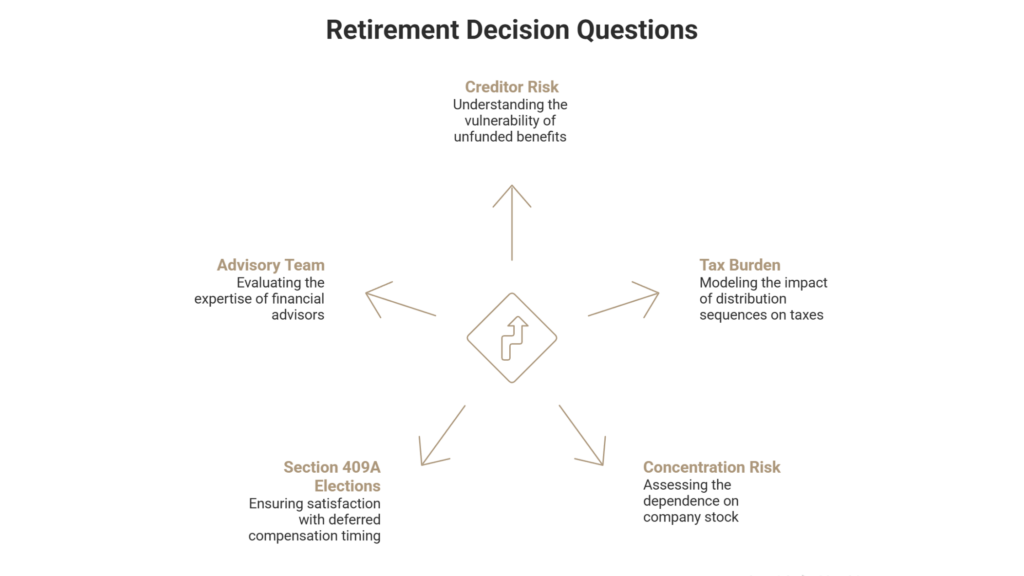
What Makes Executive Retirement Planning Different
The gap between executive compensation and standard retirement planning has widened dramatically. The median CEO at top 350 U.S. firms now earns 281 times more than the typical worker, up from 31-to-1 in 1978. This shift reflects more than just higher pay,it represents a fundamental change in how executives receive compensation.
Long-term incentives now comprise 71%-82% of total CEO compensation across company sizes. When your wealth depends heavily on equity vesting schedules, non-qualified deferred compensation accounts, and supplemental retirement plans layered on top of traditional 401(k)s, the standard retirement planning framework simply doesn’t apply.
Compensation Complexity Beyond Standard 401(k)s
Most American workers participate in straightforward retirement plans with clear contribution limits and predictable tax treatment. Your executive compensation likely includes base salary, annual bonuses, long-term incentive awards, stock options, restricted stock units, and various deferred compensation arrangements. Each component carries distinct tax implications, vesting schedules, and distribution rules.
The regulatory framework adds another layer. Qualified retirement plans follow ERISA rules requiring strict compliance with vesting, funding, fiduciary duties, and reporting standards. These plans mandate separate trust funding with assets protected from employer creditors. In contrast, supplemental retirement plans and non-qualified deferred compensation plans operate under Section 409A regulations with completely different rules. These arrangements typically remain unfunded, leaving your benefits as unsecured promises vulnerable to company financial troubles.
The Coordination Challenge: Multiple Income Streams
Picture your retirement income puzzle. You’ll likely draw from a traditional 401(k), perhaps a Roth account, deferred compensation that vests according to a predetermined schedule, a SERP that pays out over several years, stock options requiring exercise decisions, and eventually Social Security benefits. Each income source triggers different tax consequences and arrives on different timelines.
The timing challenge alone can trip up even sophisticated executives. Deferred compensation elections typically must be made well before you actually receive the money, sometimes years in advance. Stock options expire if not exercised within specified windows. SERP distributions may be tied to your separation from service date. Meanwhile, required minimum distributions from qualified plans kick in at 73, forcing withdrawals regardless of your actual cash needs. Research from Aon’s 2025 Hot Topics in Retirement and Financial Wellbeing shows that 90% of employers surveyed believe retirement preparedness is important for retaining key employees, with notable increases in key employees receiving retirement benefits as of 2025.
Red Flag: Silo Thinking
Treating your 401(k), deferred compensation plan, SERP, and equity awards as separate buckets rather than integrated components leads to higher overall taxes, suboptimal cash flow, and poor estate outcomes. The solution: model all income sources together, considering how distributions from one account affect taxes on others. At Even Path, our process focuses on this exact coordination,understanding how each decision ripples through your entire financial picture.

Understanding Your Executive Retirement Plan Options
Navigating executive retirement planning requires understanding the distinct characteristics of each benefit type. These aren’t interchangeable pieces,each carries unique tax treatment, creditor protection, and distribution requirements.
Qualified Retirement Plans: The Foundation
Your 401(k) likely serves as the bedrock of your retirement savings, offering the familiar combination of pre-tax contributions, tax-deferred growth, and employer matching. These qualified plans provide crucial creditor protection and ERISA safeguards that non-qualified arrangements lack.
The IRS imposes strict limits that particularly affect high earners. For 2026, the elective deferral limit sits at $24,500 for employees under age 50. Those between ages 50 and 59 or 64 and older can add $7,500 in catch-up contributions, while those aged 60 to 63 get enhanced treatment with $11,250 under the new super catch-up provision. The total annual additions limit combining your contributions and employer contributions reaches $72,000 in 2026, excluding catch-up contributions.
These numbers sound substantial, but they pale in comparison to executive compensation packages where base salaries alone often exceed several hundred thousand dollars. This gap between what you earn and what you can shelter in qualified plans creates the need for supplemental arrangements.
Supplemental Executive Retirement Plans (SERPs)
SERPs bridge the gap between what qualified plans can provide and the retirement income executives need. These non-qualified arrangements offer benefits beyond IRS-imposed limits on qualified plans.
Defined benefit SERPs promise a specific payout based on your final average salary and years of service. The formula might guarantee 60% of your average compensation from your final five years of service, with the SERP making up the difference between that target and what your qualified plans will provide. Defined contribution SERPs work more like enhanced 401(k) arrangements, with your employer crediting 15% to 25% of your base salary and bonus annually,far exceeding what qualified plan limits allow.
The fundamental vulnerability of SERPs stems from their unfunded nature. Unlike your 401(k) held in a protected trust, SERP benefits remain on the company’s books as a liability. You’re essentially an unsecured creditor with a promise to pay at some future date. If your employer faces bankruptcy or severe financial distress, your SERP benefits could vanish entirely.
Deferred Compensation Plans (DCPs)
Non-qualified deferred compensation plans give you control over timing your income recognition. Unlike SERPs where the company determines contribution amounts, DCPs let you choose how much salary and bonus to defer.
The strategic value becomes clear when you map out your career earnings trajectory. During your peak earning years, you’re almost certainly in the top marginal federal bracket. Deferring significant compensation during these high-income years and taking distributions in early retirement before required minimum distributions and Social Security kick in can save hundreds of thousands in taxes over your lifetime.
Section 409A regulations govern the timing and structure of deferred compensation distributions with rigid rules. You typically must elect your distribution schedule when you initially defer the compensation, choosing specific dates or events that will trigger payment. The regulations generally prohibit accelerating distributions once elected, with limited exceptions. This inflexibility requires careful planning at the outset.
Strategic Tax Planning for Executive Retirement
Tax coordination adds a critical dimension to executive retirement planning. The sequencing of withdrawals by account type creates significant long-term value,or costly mistakes.
Managing Tax Brackets Across Multiple Income Sources
Executive retirement income rarely comes from a single source. You’ll coordinate withdrawals from traditional 401(k)s, taxable investment accounts, Roth IRAs, deferred compensation distributions, SERP payments, and eventually Social Security benefits. Each source carries different tax characteristics.
The goal is filling lower tax brackets strategically before higher-bracket income arrives. Suppose you retire at 62 with several years before Social Security and required minimum distributions begin. Those early retirement years present an opportunity to realize income at 24% or lower federal rates by taking strategic distributions from 401(k)s and deferred compensation accounts. Once RMDs start at 73 and Social Security begins, your marginal rate might jump to 32% or higher.
Roth Conversion Strategies
Roth conversions deserve special attention because they offer one of the few ways to permanently escape future taxation on retirement assets. When you convert traditional retirement account balances to Roth, you pay taxes at your current rate in exchange for tax-free growth and tax-free qualified withdrawals forever after.
The optimal conversion window typically opens in early retirement after you leave your executive position but before RMDs begin. During these years, you control your income level and can realize precisely the amount needed to fill your target tax bracket. Partial conversions over several years often work better than massive one-time conversions,converting $200,000 per year for five years keeps you in a reasonable bracket, while converting $1 million in a single year would spike your rate to 37% and trigger Medicare surcharges.
State Tax Considerations for Retirement Relocation
Your state of residence at retirement can dramatically impact your after-tax retirement income. The difference between living in California with a 13.3% top rate and Florida with zero state income tax can mean hundreds of thousands of dollars over a 30-year retirement, according to analysis from Tax Foundation state tax data.
The timing of your move matters significantly for deferred compensation and SERP taxation. Most states tax these benefits based on where you were a resident when you earned the compensation, not where you live when you receive it. This sourcing approach means you can’t easily escape state taxation on benefits already earned by relocating.

Integrating Equity Compensation into Your Retirement Strategy
Equity compensation often represents the largest component of executive wealth,and the most complex to manage during retirement transitions.
Stock Options: Exercise Timing and Tax Implications
Stock options grant you the right to purchase company shares at a predetermined price. For executives, options often represent a significant component of total compensation. In S&P 500 companies, stock options averaged $1.09 million in 2024, comprising 6% of CEO pay packages, according to Equilar’s Executive Compensation Report.
Non-qualified stock options face simpler tax rules but higher rates. The spread at exercise is taxed as ordinary income, potentially pushing you into the top 37% federal bracket plus state tax and Medicare surcharges.
Red Flag: Poor Option Exercise Timing
Many executives exercise large option positions in single years, creating enormous tax bills that could have been spread across multiple years at lower marginal rates. The solution: systematic multi-year exercise schedules that fill current brackets without spiking into higher rates, ideally starting several years before expiration to maintain timing control.
Restricted Stock Units (RSUs) and Diversification
Restricted stock units dominate modern executive compensation packages, averaging $8.97 million at S&P 500 companies in 2024 and comprising 47% of total CEO pay. When RSUs vest, you recognize ordinary income equal to the fair market value of the shares received. This creates an immediate decision point: hold the shares or sell them.
Concentration in company stock represents one of the most dangerous aspects of executive retirement planning. When your salary, annual bonus, unvested equity awards, vested but unexercised options, 401(k) company stock holdings, and deferred compensation all depend on a single company’s fortunes, you’re dramatically under-diversified.
Strategic diversification involves systematic selling of vested shares while preserving enough exposure to capture upside if you’re confident in company prospects. A rule of thumb suggests limiting single-stock exposure to 10% of your total investment portfolio. Net unrealized appreciation rules provide a valuable but underutilized diversification tool for company stock held in 401(k) plans, potentially saving significant taxes compared to rolling everything to an IRA.
Common Executive Retirement Planning Mistakes to Avoid
Even sophisticated executives make predictable mistakes when coordinating complex benefits. Understanding these pitfalls helps you avoid costly errors.
Failing to Understand Deferred Compensation Risks
Your deferred compensation balance remains an unsecured promise by your employer, making you a general creditor alongside bondholders and trade vendors. If the company faces bankruptcy, you could lose part or all of your deferred compensation. Companies experiencing financial distress sometimes freeze deferred compensation plans, preventing further deferrals or distributions.
Ignoring the Impact of Medicare Surcharges (IRMAA)
Income-Related Monthly Adjustment Amounts add substantial costs to Medicare Part B and Part D premiums for high-income individuals. These surcharges catch many executives by surprise because they’re based on income from two years prior. According to Medicare IRMAA brackets for 2026, couples with income over $206,000 face IRMAA surcharges, with the top bracket kicking in above $750,000. At the highest bracket, Part B premiums reach over $10,000 per year per person.
Inadequate Estate Planning for Executive Benefits
Estate planning for executive benefits requires specialized attention because many of these assets carry unique characteristics affecting how they pass to heirs. The SECURE Act changed the rules for inherited retirement accounts, requiring most non-spouse beneficiaries to empty inherited IRAs within ten years rather than stretching distributions over their lifetimes, as noted in IRS guidance on inherited IRAs. This change dramatically increases the tax burden on beneficiaries.
Red Flag: Outdated Beneficiary Designations
Many executives named their spouse as beneficiary decades ago without considering how situations have changed through remarriage, birth of children, or evolving estate planning goals. Review all beneficiary designations annually, particularly after major life events.

5 Questions to Ask Before Making Major Retirement Decisions
When executive retirement decisions carry permanent consequences, asking the right questions helps clarify what matters most.
- Do I understand the creditor risk in my deferred compensation and SERP benefits? These unfunded promises could be lost if your company faces financial distress,how much of your retirement security depends on these vulnerable assets?
- Have I modeled how different distribution sequences affect my lifetime tax burden? The order in which you withdraw from various accounts can create six-figure differences in total taxes paid over retirement.
- What is my actual concentration risk in company stock? When you add up all your exposure,401(k) holdings, unvested equity, vested options, and deferred compensation tied to company performance,what percentage of your wealth depends on a single company?
- Am I making Section 409A elections that I’ll regret later? Once you elect a distribution schedule for deferred compensation, changing it becomes nearly impossible,are you certain about the timing you’re locking in?
- Is my advisory team equipped to handle executive-level complexity? Standard financial advisors often lack experience with non-qualified plans, equity compensation tax strategies, and the coordination required for executive transitions.
These questions point toward the need for specialized guidance. At Even Path, we work with executives navigating exactly these complexities,helping you think through decisions without the pressure of unnecessary urgency.
Building Your Comprehensive Executive Retirement Plan
Comprehensive planning requires understanding not just individual benefit components, but how they work together to support your retirement goals.
When to Start Planning
The ideal time to start serious executive retirement planning is the moment you take on a leadership role with complex compensation structures. Starting early allows you to optimize deferral elections, time stock option exercises strategically, and build wealth outside your employer’s plans. Research from Aon shows 31% of employers report participants not on track for secure retirement, often linked to low early planning and participation.
Building Your Advisory Team
No executive should attempt comprehensive retirement planning alone. The complexity requires expertise from multiple disciplines working in coordination.
Your team should include a financial advisor who understands executive compensation structures and can coordinate the various moving pieces. Look for advisors with CFP certification and specific experience working with executives. A tax advisor with experience in executive compensation adds crucial expertise around Section 409A compliance, alternative minimum tax planning, and multi-state taxation. Estate planning attorneys round out your core team.
At Even Path, our approach begins with a comprehensive inventory of all benefit plans and compensation structures. We model multiple scenarios for retirement timing, distribution elections, and tax optimization to identify the strategy best aligned with your specific goals. Our methodology focuses on practical coordination of income sources because we’ve seen how poor coordination can cost executives six figures in unnecessary taxes over retirement.
Annual Review and Adjustment
Even the best retirement plan requires regular review and adjustment to remain optimal. Your circumstances change through promotions, equity grants, changes in family situations, and evolving financial goals.
Establish an annual review process with your advisory team, ideally during the fourth quarter before you need to make deferral elections for the following year. This review should stress test your plan against different scenarios,market drops, early retirement, tax rate increases,to identify potential vulnerabilities before they become problems.
Conclusion
Executive retirement planning differs fundamentally from standard approaches because your compensation structure creates unique challenges around timing, taxation, and risk management. The decisions you face,when to take distributions, how to sequence income sources, which benefits to prioritize,carry permanent consequences that can alter your retirement by hundreds of thousands of dollars.
Professional guidance from a fiduciary advisor who understands executive compensation helps you navigate these complexities without the pressure of unnecessary urgency. At Even Path, we believe clarity matters more than speed when the decisions are permanent. We work with executives navigating complex transitions, helping them understand their complete picture before making irreversible choices.
When you’re ready to explore how we might help with your executive retirement transition, schedule an initial conversation. We’ll discuss your specific situation and determine whether our approach aligns with your needs,without pressure, without urgency, and with your interests as our only priority.
When the decisions are permanent, clarity matters more than speed.