Depression After Retiring: Recognizing the Signs and Finding Your Path Forward
Depression after retiring affects more people than you might expect, yet the transition from decades of structured work life to open-ended retirement days catches many by surprise. You worked toward this goal for years, built your identity around professional achievements, and looked forward to the freedom retirement would bring. Then it arrives, and instead of relief, you feel untethered. The alarm clock stays silent, but so does your sense of purpose.
This disconnect between expectations and reality is documented and common. Research shows that 13.2% of adults aged 65 and older experienced depressive symptoms in 2020, with retirement transitions serving as a major trigger. At Even Path, we work with individuals navigating these exact challenges, helping them understand that what they’re experiencing is neither personal failure nor permanent. It’s a documented psychological response to one of life’s most significant transitions, and it comes with proven pathways forward.
Understanding what you’re facing helps you know when to seek support and how to move forward with clarity.
TL;DR: Depression After Retiring
Depression after retiring stems from losing the identity, purpose, social connections, and structure that work provided for decades. Unlike normal retirement adjustment, which improves within weeks, clinical depression brings persistent symptoms that interfere with daily functioning and may worsen over time. The condition manifests through emotional changes like persistent sadness and hopelessness, physical symptoms like fatigue and sleep disturbances, and behavioral shifts like social withdrawal and loss of interest in previously enjoyed activities. Risk factors include financial insecurity, weak social networks, strong work identity, involuntary retirement, and pre-existing health issues. Recovery requires rebuilding purpose through structured daily routines, combating isolation with strategic social connections, maintaining physical health as a mental health foundation, processing the identity transition with professional support when needed, and addressing financial anxiety proactively. Professional help becomes essential when symptoms persist beyond two weeks despite self-help efforts, when you’re struggling with basic self-care, or when thoughts of death emerge. With the right combination of structure, connection, purpose, and professional guidance when needed, most people experiencing depression after retiring can reclaim their wellbeing and discover what retirement offers when it’s no longer defined by depression.
Key Points
- Retirement depression differs from normal adjustment because symptoms persist or worsen over time rather than gradually improving, and they interfere with your ability to function in daily life
- The transition strips away professional identity, daily purpose, social connections, and imposed structure simultaneously, creating conditions that trigger depression even in those who looked forward to retirement
- Physical symptoms often get dismissed as normal aging when they actually signal depression—persistent fatigue, unexplained aches, and sleep disturbances warrant mental health evaluation
- Financial anxiety amplifies depression risk, with 30% of U.S. retirees in 2024 reporting trouble making ends meet, making proactive financial planning essential for mental health
- Rebuilding daily structure and purpose requires deliberate effort—waiting for meaning to appear naturally rarely works, but behavioral activation techniques that track mood patterns can identify what actually helps
- Social isolation significantly increases depression likelihood, with those living alone facing 54% higher risk, making strategic reconnection critical for recovery
- Professional help becomes necessary when symptoms persist beyond two weeks, when you’re struggling with basic self-care, or when any thoughts of death or suicide emerge
- Even Path approaches retirement transitions differently—we help you process both the financial and emotional dimensions of this life change, recognizing that your mental wellbeing and financial security are inseparable during major transitions
Table of Contents
Toggle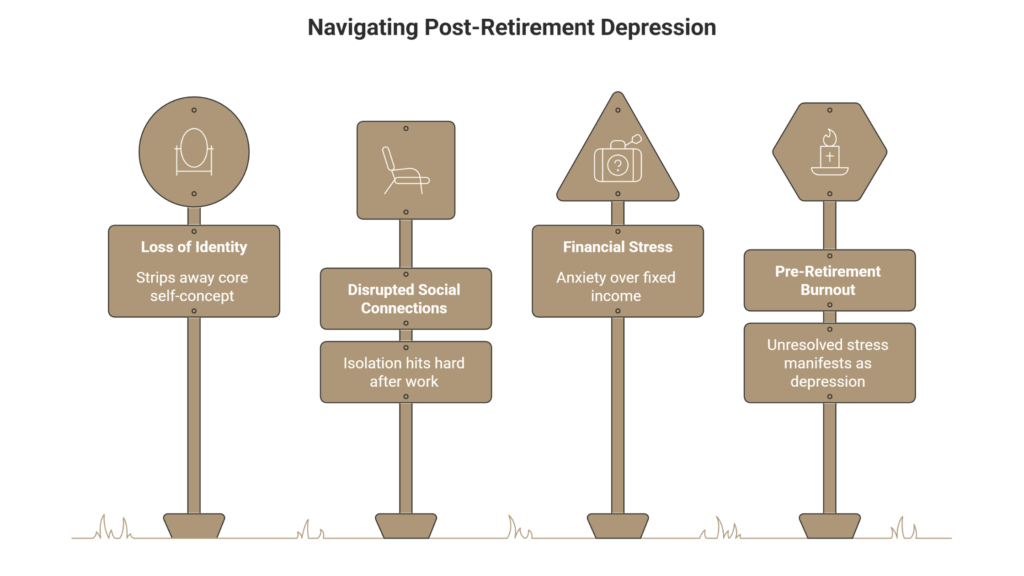
Understanding Depression After Retiring vs. Normal Adjustment
Knowing the difference between normal retirement adjustment and clinical depression helps you recognize when you need professional support.
What Retirement Depression Actually Is
Retirement depression isn’t listed as a distinct diagnosis in the DSM-5. Mental health professionals describe it as situational depression triggered by the retirement transition. The symptoms align with standard criteria for major depressive disorder, but the catalyst is clear: leaving the workforce.
When someone develops persistent sadness, fatigue, and loss of interest specifically following retirement, clinicians categorize it as an adjustment disorder with depressed mood. This can persist for weeks or months during adaptation. What makes this particularly challenging is that these symptoms frequently go underreported among retirees, complicating diagnosis when they overlap with other age-related health conditions.
How It Differs From Typical Retirement Adjustment
Every retiree faces an adjustment period. You’re learning to fill time previously claimed by work and redefining your daily purpose. This normal adjustment might include restlessness or uncertainty about how to structure your days. These feelings typically ease within weeks as you establish new patterns.
Depression crosses a different threshold. While typical adjustment involves temporary discomfort, clinical depression brings persistent symptoms that interfere with your ability to function. Normal adjustment might mean feeling unsettled about Mondays without work. Depression means struggling to get out of bed most mornings, losing interest in activities you once loved, and feeling hopeless about the future. The timeline matters—regular retirement adjustment gradually improves as you adapt, while depression either persists without improvement or worsens over time.
Why Retirement Triggers Depression: Common Underlying Causes
Understanding what drives depression after retiring helps you address root causes rather than just managing symptoms.
Loss of Identity and Purpose
Your professional identity shaped decades of your life. Retirement strips away this core piece of self-concept. You transition from a specific role that defined you to simply being retired. For executives and business owners, this identity crisis intensifies—research shows that 36% of business owners prioritize non-financial professional goals during retirement planning, compared to general employees who focus primarily on financial security.
The loss extends beyond identity to daily purpose. Work provided clear objectives, measurable achievements, and external validation. Retirement removes these markers of value, leaving many struggling to identify what makes their days meaningful. At Even Path, we help clients process this identity transition, recognizing that grief over lost professional roles is legitimate and requires space to work through.
Disrupted Social Connections and Isolation
Your workplace served as more than an income source—it was a social ecosystem where you built relationships over years of shared challenges. Research shows that post-retirement social relationship changes significantly increase depressive symptoms. When colleague contact disappears and work-related social activities end, the resulting isolation hits hard.
You might go from daily interactions with dozens of people to days where you barely speak to anyone. Studies indicate that loneliness partially mediates the link between social changes and depression, accounting for nearly 12% of the effect. U.S. daily loneliness reports reached 21% in 2025, the highest level since 2021, according to Gallup research on loneliness trends.
Financial Stress and Uncertainty
Money concerns loom large for many retirees. The transition from regular paychecks to fixed income creates anxiety even when retirement savings exist. Data shows that 30% of U.S. retirees in 2024 report trouble making ends meet, according to research from the Transamerica Center for Retirement Studies. This financial fragility directly contributes to emotional distress.
For business owners who built significant wealth but lack liquid retirement funds, this manifests differently. 74% of business owners plan to sell or transfer their business, yet most lack succession plans. The gap between business value on paper and actual retirement cash flow creates persistent anxiety about whether you can truly afford to stop working.
Pre-Retirement Burnout and Accumulated Stress
Work often served as a distraction from personal problems, but for executives and leaders, it also generated extraordinary stress. Research indicates that executives report 67-82% more stress in 2025 than the prior year, with 55% of CEOs experiencing mental health issues in 2024, up 24 percentage points year-over-year, according to BambooHR’s survey of executive mental health.
When retirement strips away these high-pressure roles, unresolved stress and burnout don’t simply disappear. Instead, they manifest as depression once the adrenaline of constant decision-making fades. Studies show that 61.6% of older adults with current depression had prior symptoms between ages 50-64, revealing how pre-retirement mental health issues predict post-retirement struggles.

Warning Signs of Depression After Retiring
Recognizing symptoms early allows you to seek support before depression becomes entrenched. These signs warrant attention.
Emotional and Cognitive Symptoms
Depression announces itself through persistent emotional changes that feel different from temporary low moods. You might experience a sad, anxious, or empty mood that lingers day after day. Feelings of hopelessness about the future become particularly telling. Many retirees with depression feel guilty about not enjoying retirement when others insist these should be the best years.
Cognitive symptoms manifest in ways that might initially seem like normal aging. Trouble concentrating on conversations, difficulty making decisions about simple matters, and problems remembering recent events all appear. These cognitive issues can mimic early dementia, but they stem from depression’s impact on mental processing. Irritability and restlessness surprise many retirees who expected depression to look like sadness—this presents especially in older men, who may express depression through irritability rather than acknowledging sadness.
Physical Symptoms Often Overlooked
Physical manifestations of retirement depression frequently get dismissed as normal aging. Profound fatigue that makes even simple tasks feel exhausting becomes a dominant feature. You might sleep longer but wake feeling unrested, or find that getting dressed and making breakfast depletes your energy for the day.
Unexplained physical complaints often serve as depression’s calling card in older adults. Persistent aches, pains, or gastrointestinal issues without clear medical causes warrant attention for underlying depression. Research indicates that 80% of older adults with depression have chronic conditions, making it harder to distinguish depression-related symptoms from other health issues, according to studies on depression in older adults.
Behavioral Changes to Watch For
Loss of interest in previously enjoyed activities stands out as a key behavioral marker. Hobbies you once pursued eagerly now feel pointless or like too much effort. Social withdrawal intensifies over time—phone calls go unreturned, visits get canceled, and you increasingly isolate yourself at home. Family members often notice this pulling away before you fully recognize it yourself.
Thoughts of death or suicide represent the most serious warning sign. These might start as passive wishes that you simply wouldn’t wake up, then progress to more active ideation. Any suicide-related thoughts demand immediate professional help. Call 988 immediately if you’re experiencing suicidal ideation.
Proven Solutions to Overcome Depression After Retiring
Recovery requires deliberate action across multiple dimensions. These strategies work when implemented consistently.
Rebuild Purpose and Structure in Your Days
Creating new purpose requires deliberate effort rather than waiting for meaning to appear. Start by identifying activities that align with your core values. What mattered beyond career success? Family connections, creative expression, community contribution, continuous learning, or physical challenges might surface as priorities you’ve neglected during working years.
Behavioral activation techniques prove particularly effective. Track daily activities and rate your mood before and after each one. You’ll identify patterns showing which activities boost mood versus those that drain energy. Set specific, achievable goals for each week, breaking larger aspirations into weekly objectives that create a sense of accomplishment. If you see no improvement after 6-8 weeks of consistent effort, this signals need for professional intervention rather than continuing to struggle alone.
Combat Isolation Through Strategic Social Connection
Rebuilding social connections requires intentional strategy after work friendships fade. Schedule regular social contact just as you’d schedule medical appointments. Commit to one lunch per week with friends, a standing coffee date, or joining a recurring group activity. Putting these commitments on your calendar and treating them as non-negotiable prevents the isolation that creeps in when you keep postponing social plans.
Join groups centered around interests or activities rather than age. While senior centers offer value, limiting yourself to age-segregated settings reinforces feeling old and retired rather than simply human. Look for hobby groups, volunteer opportunities, recreational sports leagues, or classes where you’ll meet people of various ages who share your interests. Research shows it takes three exposures to feel comfortable in new social settings—most people report feeling uncertain after the first meeting but find comfort levels jump significantly by the third.
Maintain Physical Health as a Mental Health Foundation
Physical activity directly combats depression through multiple biological and psychological mechanisms. Exercise increases endorphin production, improves sleep quality, reduces inflammation linked to depression, and provides a sense of accomplishment. You don’t need intense workouts—moderate activity like brisk walking for 30 minutes most days delivers significant mental health benefits.
Start where you are rather than where you think you should be. If you’re currently sedentary, begin with five-minute walks and gradually increase duration as your stamina improves. The consistency of daily movement matters more than the intensity or duration of any single session. Most retirees report mood improvements within 4-6 weeks of implementing structured routines.
Process the Transition and Redefine Your Identity
Grieving your work identity is legitimate and necessary. You lost something significant when you retired—a sense of who you were, daily purpose, professional relationships, and perhaps status or influence. Acknowledging this loss and allowing yourself to feel sad about it paradoxically helps you move forward.
Work with a therapist specializing in life transitions to process retirement’s emotional impact. Cognitive-behavioral therapy helps identify and challenge thought patterns that worsen depression. You might believe “I’m useless without work” or “My best years are behind me.” A skilled therapist helps you recognize these thoughts as depression’s distortions rather than objective reality. At Even Path, we recognize that financial guidance during retirement transitions must address both the practical and emotional dimensions of this life change.
Manage Financial Anxiety Proactively
Confronting financial realities directly reduces the anxiety that vague money worries create. Schedule a comprehensive financial review with a fiduciary advisor who specializes in retirement planning. Bring all relevant documents—Social Security statements, retirement accounts, pension information, and monthly expenses.
Create a realistic monthly budget that accounts for all expenses including irregular ones people often forget. Healthcare costs, home and car maintenance, insurance premiums, and taxes need inclusion alongside obvious expenses. Most retirees report reduced financial anxiety within three months of creating a clear financial picture, even when that picture reveals challenges requiring solutions.

When to Seek Professional Help for Retirement Depression
Recognizing when self-help strategies aren’t sufficient requires honest self-assessment. Professional intervention may be necessary in specific situations.
Signs You Need More Than Self-Help
Persistent symptoms lasting more than two weeks despite your efforts signal that professional intervention may be necessary. When sadness, hopelessness, or anxiety continue day after day without relief, you’re dealing with clinical depression that needs expert treatment. Functional impairment indicates you’ve crossed into territory requiring professional help—if you’re struggling to maintain basic self-care like showering, eating regular meals, or managing medications, that’s a red flag.
Physical symptoms without clear medical causes deserve mental health evaluation. When you’ve seen doctors for persistent pain, fatigue, digestive issues, or other physical complaints but tests reveal no underlying medical problems, depression may be the root cause. Substance use changes serve as warning signs—if you’re drinking more frequently to manage difficult emotions or using medications differently than prescribed to numb feelings, professional help becomes critical.
Treatment Options That Work
Psychotherapy, particularly cognitive-behavioral therapy, shows strong effectiveness for treating depression in older adults. CBT targets current problems and symptoms, focusing on the relationship among behaviors, thoughts, and feelings. Research shows CBT maintains its effectiveness at six-month follow-up, making it a durable treatment option, according to studies on CBT for late-life depression.
Group Cognitive-Behavioral Therapy offers particular value as a first-line psychotherapy for retirees. Group settings connect you with others facing similar transitions while providing professional guidance. Collaborative care models that combine education, behavioral activation, and regular provider check-ins demonstrate particular success with retirement depression. Antidepressant medications remain an important treatment option, particularly for moderate to severe depression, though medication combined with therapy typically works better than either alone.
5 Signs You Need Professional Guidance During Retirement Transitions
Knowing when to seek support helps you address problems before they become entrenched. Watch for these indicators.
- Your symptoms persist beyond two weeks despite consistent self-help efforts. When sadness, anxiety, or hopelessness continue day after day without improvement, professional intervention becomes necessary rather than optional.
- You’re struggling with basic self-care and daily responsibilities. If showering feels like too much effort, household tasks pile up, or you’re missing appointments due to lack of motivation, you’ve crossed into clinical territory.
- Financial anxiety keeps you awake at night despite having retirement savings. When money worries dominate your thoughts even though you’re financially secure on paper, you need both financial clarity and mental health support.
- You’ve completely isolated yourself from friends and family. If weeks pass without meaningful social contact and you’re actively avoiding people who care about you, isolation has become dangerous.
- Any thoughts of death or suicide have emerged. Even passive wishes that you wouldn’t wake up warrant immediate professional help. Call 988 if you’re experiencing any suicidal ideation.
Professional support during major life transitions isn’t a sign of weakness—it’s recognition that some challenges require expertise beyond what self-help can provide.

Creating Your Personalized Recovery Action Plan
Building your recovery plan starts with honest assessment of where you are currently and clear steps forward.
Establish Clear, Achievable Goals
Rate your depressive symptoms on a scale of 0-10 for the past two weeks. Identify which symptoms trouble you most—persistent sadness, lack of energy, social isolation, or something else. This baseline helps you measure progress and adjust your plan as needed.
Establish three to five specific, measurable goals for the next month. Make these realistic given your current state rather than overwhelming aspirations. Your goals might include taking a 15-minute walk five days per week, calling one friend weekly, establishing a consistent sleep schedule, or attending one social activity. Write goals in positive terms focused on what you will do rather than what you’ll avoid.
Build Accountability and Review Progress
Share your goals with a trusted friend or family member who will check in on your progress regularly. Schedule a weekly review session with yourself where you assess what’s working, what isn’t, and what adjustments to make. If you see no improvement after 6-8 weeks of consistent effort, this signals need for professional intervention rather than continuing to struggle alone.
Plan for maintenance once symptoms improve. Depression recovery isn’t a destination you reach and forget about. Your action plan should include strategies for sustaining improvements and catching warning signs early if symptoms begin returning. Treating your recovery plan as a living document that evolves with your needs increases its long-term value.
Conclusion
Depression after retiring affects millions of Americans navigating one of life’s most significant transitions. Research indicates that up to 40% of retirees experience depression at some point after leaving the workforce, yet only 27% feel prepared for retirement’s emotional challenges. These numbers reveal both the scope of the challenge and the opportunity for improvement through intentional support.
Recovery requires rebuilding the structure, purpose, social connections, and sense of identity that work once provided. This happens through deliberate action—establishing daily routines, reconnecting strategically with others, maintaining physical health, processing the identity transition with professional support when needed, and addressing financial concerns proactively. Professional help becomes essential when symptoms persist despite self-help efforts, when basic functioning becomes impaired, or when any thoughts of death emerge.
At Even Path, we recognize that retirement transitions involve both financial and emotional dimensions that cannot be separated. We work with individuals navigating these complexities, helping them understand their options and make decisions aligned with their wellbeing rather than reacting to pressure or uncertainty. Our fiduciary commitment means your interests guide every recommendation, and our experience with life transitions means we understand that clarity matters more than urgency when the changes are this significant.
When you’re ready to explore how we might support your retirement transition, schedule a conversation. We’ll discuss your specific situation and determine whether our approach aligns with your needs—without pressure, without urgency, and with your wellbeing as our only priority.
When the transition feels overwhelming, support that helps you think clearly makes all the difference.