Leaving the workforce doesn’t just mean goodbye to a paycheck. For many, it means losing the daily conversations, the shared purpose, and the automatic social structure that work provides. Research shows that loneliness peaks one year post-retirement, catching many retirees off guard just when they expected to feel most free. But retirement loneliness isn’t inevitable, and the solutions that work best in 2026 look different from the generic advice you’ve heard before.
Even Path is a fiduciary financial guidance firm that works with people navigating the full complexity of retirement, including the social and emotional dimensions that standard financial planning rarely addresses. Explore Even Path’s retirement services to understand how a fiduciary advisor supports the whole transition.
Retirement Is a Financial and Emotional Transition. Both Deserve Attention.
The isolation and identity shifts that come with leaving the workforce often connect directly to how financial decisions get made. Even Path helps retirees bring clarity to both sides. Schedule a conversation to start with a clear picture of where you stand.
TL;DR: Retirement Loneliness
Retirement loneliness is common, peaks in the first year after leaving work, and stems from the simultaneous loss of identity, routine, and built-in social networks. Generic advice like “join a club” often fails because it ignores the psychological barriers involved and the depth of what has actually been lost. The strategies that work combine intentional, repeated engagement with interest-based communities, a structured weekly social framework, and patience with a process that takes months rather than days. When loneliness deepens into persistent sadness or loss of motivation, professional support is available and effective. The goal is not to replicate what work provided, but to build something new that fits who you are now.
Key Points
- Retirement loneliness peaks in year one. Research tracking retirees found emotional isolation rises sharply in the first year, making early, intentional action especially important.
- The loss is three-layered. Identity, daily routine, and automatic social networks disappear simultaneously, which is why the experience feels disorienting even when retirement was planned.
- Generic advice consistently falls short. 33% of adults 50-80 experienced loneliness in 2024 despite following conventional “stay active” advice. Quality and type of engagement matters more than quantity.
- Repeated exposure builds real friendships. One-off events rarely create lasting connections. Weekly commitments to consistent groups allow relationships to develop naturally.
- Interest-based groups outperform age-segregated ones. Activities built around shared passions, rather than shared age, tend to produce richer connections and broader perspectives.
- Know the warning signs. Persistent sadness lasting more than two weeks, loss of interest in previously enjoyed activities, and sleep or appetite changes can signal a shift from normal adjustment to clinical depression.
- Professional support works. 63% of tested interventions were found effective or partially effective for reducing loneliness in older adults.
- Even Path sees the full picture. Isolation and emotional stress affect financial decision-making in ways that are often invisible to the person experiencing them. Fiduciary guidance helps separate the two.
Table of Contents
Toggle
Understanding Why Retirement Loneliness Feels Different
The Triple Loss: Identity, Routine, and Built-In Social Networks
Most retirement planning focuses on financial readiness. Few people prepare for the emotional whiplash that comes from suddenly losing three things at once: who you are, what you do every day, and the people you see regularly.
Your work identity shaped how you introduced yourself for decades. Retirement strips that away, leaving many feeling uncertain about their place in the world. This identity crisis compounds the practical loss of routine—without meetings, deadlines, or projects, days blur together. The social network loss hits hardest. Your work colleagues weren’t just people you saw occasionally; they were built-in social interactions that happened automatically, requiring no planning or effort.
According to 40% of U.S. adults 45+ now report feeling lonely, driven largely by shrinking social networks and reduced contact with former colleagues. These lonely adults spend an average of 7.3 hours alone each day, highlighting how dramatically retirement can shift your social landscape.
The timing matters more than most people realize. Research tracking 75 retirees found that emotional isolation rises sharply during the first year post-retirement, with feelings of being alone intensifying more dramatically than the loss of companionship. This isn’t just about missing workplace chatter—it’s about losing the sense of belonging that comes from being part of something larger than yourself. The transition itself drives the spike, making early intervention crucial for building new routines before isolation becomes entrenched.
Why Traditional Advice Often Falls Short
“Join a club” or “volunteer somewhere” sounds reasonable until you’re actually retired and lonely. This advice fails because it oversimplifies a complex problem and ignores the psychological barriers that make implementing these suggestions harder than they sound.
First, traditional recommendations rarely acknowledge that many retirees feel exhausted by the idea of starting over socially. Building new friendships from scratch at 65 requires different energy than it did at 25. You’re seeking meaningful connections that can partially replace the depth of relationships you built over decades at work, not just activities to fill time.
Second, generic advice doesn’t account for the vulnerability many feel when retired and alone. Walking into a room full of strangers takes courage even when you’re confident. When you’re already feeling isolated and questioning your value, that first step feels impossibly hard.
Third, much retirement advice treats all social activities as equally valuable. Research shows this isn’t true. 33% of older adults aged 50-80 experienced loneliness in 2024, despite many following conventional advice to “stay active.” The quality and type of social engagement matters more than simply keeping busy. Evidence shows that multi-objective interventions combining social skills, support opportunities, and cognitive reframing significantly outperform single-strategy approaches, with 88% of psychological therapy interventions and 67% of multi-category programs incorporating three or more objectives proving most effective.
The real issue is that traditional advice addresses surface-level symptoms rather than the deeper transition. Being retired bored and depressed stems from losing purpose and meaningful social roles, not just lacking activities.
The emotional experience of retirement connects more directly to financial decisions than most people expect. When identity is in flux and isolation sets in, it can affect how retirees evaluate risk, spend, and plan. Even Path uses psychometric assessments alongside financial analysis to help clients understand both their risk tolerance and their emotional readiness for major financial decisions. Learn more about how Even Path’s process works to see what that looks like in practice.
Building Local Community Connections That Stick
Strategic Volunteering: Finding Purpose and People Simultaneously
Volunteering works when it’s strategic, not random. The key is choosing opportunities that align with your interests while naturally creating regular contact with others who share those passions.
Implementation Timeline: Katherine’s First 90 Days
Katherine’s experience after relocating to North Carolina illustrates a concrete progression from isolation to connection:
Weeks 1-4: A volunteer driver named Nancy took her to a medical appointment and encouraged her to try a Tai Chi class for her poor balance issues. Katherine attended her first session feeling anxious about entering a room full of strangers. She sat in her car for 15 minutes before the class, then walked in during the warm-up exercises, which actually made joining easier than arriving early.
Weeks 5-8: By week five, Katherine recognized three regular faces and started arriving five minutes early to exchange hellos. Week seven brought her first real conversation beyond pleasantries—discussing a upcoming community event with two classmates. The physical activity itself helped; the endorphins from movement made social interaction feel less forced.
Weeks 9-12: Katherine exchanged phone numbers with two regular attendees. By week twelve, they’d had coffee once outside of class. More importantly, she stopped feeling dread about attending. The class became something she looked forward to rather than forcing herself through.
Months 4-6: The initial connections expanded. Katherine joined a second weekly activity one classmate mentioned. The compound effect became visible—each new connection introduced her to additional people and activities. As the program notes, she went from merely existing to living a fulfilling life through these new connections.
Common obstacles Katherine navigated: Early anxiety about attending alone (solution: committed to four sessions before judging); feeling physically inadequate compared to others (solution: focused on personal progress, not comparison); uncertainty about how to deepen casual friendships (solution: specific invitations to low-pressure activities like walking).
The pattern that works involves volunteering for causes where you’ll see the same people repeatedly. One-off volunteer days rarely build lasting friendships. Weekly commitments at food banks, museums, libraries, or community centers create the repeated exposure that allows relationships to develop naturally.
Purpose matters as much as people. Laura, a diabetic retiree, joined chair yoga, line dance, and cooking programs at her local Shepherd’s Center. She started carpooling weekly with three new friends she met there. Her health improved so dramatically that her doctor removed her from insulin, and she increased her yoga attendance to three times weekly. The combination of purpose, routine, and emerging friendships created a reinforcing cycle that addressed both her physical and emotional needs.
Creating Your Own Social Circle: A 30-Day Action Plan
Starting from scratch feels daunting, but breaking it into manageable weekly steps removes some of the overwhelm.
Week 1: Research and Commit
- Monday-Wednesday: Research three local activities matching your interests (exercise classes, hobby groups, volunteer opportunities). Visit websites, read reviews, call to ask about typical attendance and newcomer experience.
- Thursday: Choose one activity with the lowest barrier to entry. Priority goes to weekly commitments starting soon.
- Friday-Sunday: Address practical logistics. What will you wear? How will you get there? Plan arrival for 5-10 minutes before start time (early enough to not rush, not so early you’re waiting alone awkwardly).
Week 2: Show Up
- Attend your chosen activity. Your only goal this week is physical presence. Don’t pressure yourself to make friends or have meaningful conversations.
- After attending, spend 10 minutes noting: Who seemed approachable? What made you comfortable or uncomfortable? Would you return?
- Commit to three more sessions before deciding whether to continue.
Week 3: Initiate Simple Contact
- Arrive at the same time each session to see consistent faces. Position yourself near someone who seems welcoming.
- Use these low-pressure conversation starters: “Is this your first time with this group?” “I’m still learning—do you have any tips?” “That was harder than I expected—how long have you been coming?”
- Goal: Learn two people’s names by end of week.
Week 4: Extend Beyond the Activity
- After class, when saying goodbye to someone you’ve chatted with twice, try: “I’ve enjoyed talking with you these past few weeks. Would you be interested in grabbing coffee at [specific nearby coffee shop] next [specific day] at [specific time]?”
- If they decline, that’s valuable information (they might not be seeking new friendships), not personal rejection. Move to the next promising person.
- If they accept, keep the first meetup short (30-45 minutes). You’re testing compatibility, not forcing instant deep friendship.
Ray’s story demonstrates how multiple small connections snowball. Struggling with technology isolation, he was matched with volunteer Al for tablet training so he could connect with his nephew. That led to coordination for medical transport, and eventually volunteer Daphne provided full support for a delayed colonoscopy. As the organization describes, these blossoming volunteer friendships enabled Ray to get necessary medical care while building a support network.
Conversation Scripts That Work:
When approaching someone after a class: “I’ve enjoyed seeing you here the past few weeks. Would you be interested in grabbing coffee at Main Street Café next Tuesday at 10am?”
If they decline: “No worries! Maybe another time.” Then give yourself credit for trying.
If they accept but cancel: Wait a week, then try once more: “Would you like to reschedule for next week?” If they decline again, move on.
For follow-up after first coffee: “I really enjoyed our conversation. Would you like to [specific activity] in two weeks?”
Interest-Based Groups vs. Senior-Only Activities: Making the Right Choice
Age-segregated activities sound appealing in theory but often feel limiting in practice. Interest-based groups that welcome all ages typically offer richer experiences and broader perspectives.
Think about what genuinely interests you, not what you think retirees “should” do. If you’re passionate about photography, join a camera club that includes working professionals and hobbyists of all ages. You’ll learn more, encounter fresh viewpoints, and avoid the echo chamber that sometimes develops in senior-only settings.
Senior-only activities work best when they’re part of a broader mix. A weekly senior fitness class provides peer connections with people navigating similar life stages. But balancing it with a book club, community theater group, or political action committee that spans generations keeps your social world more dynamic.
Research shows that contact with neighbors and friends increases most sharply after retirement. 65% of retirees report weekly contact with neighbors, replacing lost workplace ties. These casual peripheral connections combat loneliness effectively. Interest-based activities naturally expose you to both weak ties from fellow hobbyists and potential stronger friendships with people you see repeatedly.
Leveraging Digital Connections Without Replacing Real Ones
Virtual Communities and Online Groups That Combat Isolation
Digital platforms can genuinely reduce isolation when used as a complement to, not replacement for, in-person interaction. The key is choosing communities that match your interests and engagement style.
Facebook remains the primary platform retirees use for social connection in 2025-2026, particularly through community groups focused on specific topics. Senior living communities report significant increases in reactions and comments from high-quality video content showing residents living actively.
Look for online groups that emphasize mutual support and regular interaction rather than passive scrolling. Chronic illness support groups, hobby-specific forums, and local community pages that discuss neighborhood issues create ongoing conversations where you become a recognized member. The repeated interaction with the same virtual faces builds familiarity similar to seeing neighbors regularly.
The pattern that prevents digital connections from replacing real ones involves using online groups as a starting point for local meetups or as maintenance between in-person gatherings. A book club might have a private Facebook group where members share quotes and reactions throughout the month, with online discussion enhancing monthly face-to-face meetings rather than replacing them.
Video Calling Strategies That Actually Strengthen Relationships
Video calls feel awkward initially for many retirees, but they can maintain and even deepen long-distance relationships when approached strategically.
Schedule regular video calls with distant family or old friends rather than waiting for spontaneous timing to work. Weekly Sunday morning coffee over video with a former colleague creates reliable connection that mimics the regularity you had when working together. The predictability matters more than the duration—thirty minutes weekly builds stronger bonds than sporadic hour-long calls every few months.
Use video for activities beyond conversation. Watch a movie simultaneously while on video chat, giving you shared experience to discuss. Cook the same recipe “together” over video, comparing techniques and results. These structured activities reduce the pressure of maintaining continuous conversation while creating meaningful shared time.
For retirees who are managing the broader emotional weight of this transition, it helps to understand that depression after retiring is a recognized and treatable pattern. The article depression after retiring: recognizing the signs and finding your path forward covers the warning signs in depth and outlines practical paths toward support.
Developing a Sustainable Social Routine for Solo Retirees
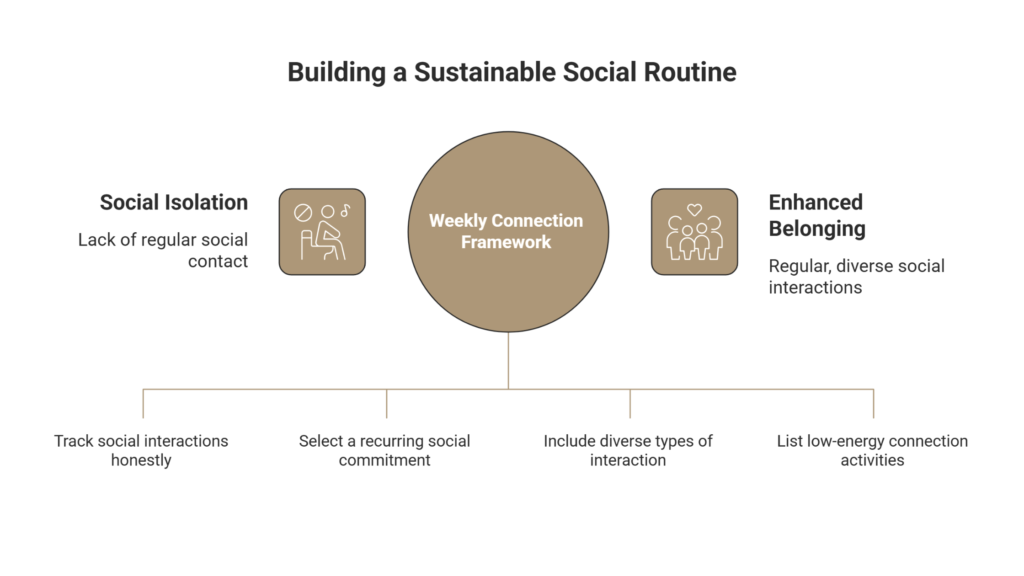
The Weekly Connection Framework: Your Personalized Template
Creating a sustainable social routine requires enough structure to ensure regular contact without becoming so rigid that it feels like another job.
Step 1: Audit Your Current Week
Track one typical week honestly. Count hours spent with others versus alone. Note which interactions left you feeling more connected versus drained.
Current weekly social touchpoints: Hours spent in meaningful conversation: Hours spent alone: _
Goal: Aim for 3-4 quality social interactions weekly through diverse channels.
Step 2: Choose Your Anchor Activity
Select one recurring commitment that happens the same day/time each week. This becomes your reliable social baseline.
Criteria for selection:
- Genuinely interests you (not just “should” do)
- Involves seeing same people repeatedly
- Matches your current energy level
- Scheduled when you’re typically most alert
My anchor activity: _ Day/Time: _ Start date: _
Step 3: Add Variety Across Connection Types
Build in multiple types of interaction to prevent burnout:
- Group activity (anchor activity counts here)
- One-on-one connection (coffee, phone call, walk)
- Community presence (volunteering, attending event)
- Digital connection (video call, active online group participation)
You don’t need all four every single week. Aim for 3-4 total touchpoints with at least two different types.
Step 4: Create Low-Energy Backup Options
List three activities requiring minimal energy but still providing connection:
- Standing video call with friend/family
- Posting in online community group
- Walking around neighborhood waving to familiar faces
Use these on low-energy days instead of canceling all social contact.
Research shows that frequent peripheral ties and diverse connections enhance belonging regardless of close network size. Your framework should include both: weak ties from regular activities like fitness classes or volunteer work, plus deeper connections from one-on-one time with emerging friends.
Studies indicate diminishing returns to daily face-to-face interactions for older adults, suggesting that moderate-frequency diverse engagements optimize well-being better than daily overload.
Tracking What Works: Your Quarterly Check-In
Keep a simple journal noting which activities you attended, how long they lasted, and how you felt afterward. Rate your mood and energy on a basic scale. After several weeks, patterns emerge showing which connections genuinely improve your well-being versus which ones you pursue out of obligation.
Notice which relationships are reciprocal versus one-sided. Healthy friendships involve give and take. If you’re always initiating contact or consistently feeling drained after time with certain people, those connections might need adjustment or gentle distance.
Be willing to quit activities that aren’t working. Many retirees force themselves to continue attending groups out of guilt or fear of seeming flaky. If you’ve given something several genuine attempts and it consistently feels wrong, stopping is wise.
Reassess quarterly. Your needs and circumstances evolve, particularly in early retirement. Regular check-ins prevent you from operating on autopilot with a routine that no longer serves you.
Retirement Involves More Than Financial Readiness. Even Path Addresses Both.
The anxiety and disorientation that come with early retirement often intersect with financial decisions in ways that are worth examining carefully. Even Path helps retirees slow down and think clearly about both the emotional and financial dimensions of this transition. Explore Even Path’s retirement planning approach to see how this kind of guidance works.

Addressing Depression and Deep Isolation
Recognizing When Loneliness Becomes Clinical Depression
Understanding the distinction between normal loneliness and clinical depression is critical for knowing when to seek professional help.
Depression prevalence is significant among retirees. Research shows a 28% rate affects approximately one in three retirees, substantially higher than the general older adult population. This elevated risk stems from the compound challenges of identity loss, routine disruption, and social disconnection.
Professionals highlight a specific threshold where normal post-retirement loneliness becomes clinically concerning: when it persists beyond the initial year or leads to health declines like reduced self-esteem and physical activity. Research tracking 600 retirees found loneliness negatively impacts health significantly, while self-esteem and activity offer protective buffers—when these erode, the shift to clinical concern becomes evident.
Key warning signs include persistent sadness lasting most of the day for two weeks or more, loss of interest in previously enjoyed activities, significant changes in appetite or sleep patterns, difficulty concentrating, and thoughts that life isn’t worth living. If you’re experiencing several simultaneously, professional assessment is warranted.
Context matters significantly. 54.3% increased risk of depression symptoms affects adults living alone compared to those not living alone. For retirees who are both living alone and childless, the risk increases by 46%. Mandatory retirement, retirement due to illness, and anticipated retirement present higher depression levels than voluntary retirement.
The current U.S. depression rate reached 18.3% in 2025, representing approximately 47.8 million Americans. These statistics underscore that depression is common, treatable, and nothing to feel ashamed about addressing directly.
Professional Support Options: What Works Best
Multiple professional pathways exist for addressing retirement-related depression and deep isolation. Evidence shows that combining approaches yields better outcomes than single interventions.
Cognitive Behavioral Therapy helps reshape thinking patterns and develop new perspectives on the retirement transition. CBT practitioners work with you to identify negative thought loops—like “I’m useless now that I’m not working”—and replace them with more accurate, balanced thinking. This structured approach typically involves sessions with homework between meetings.
Support Groups offer peer connection alongside therapeutic benefit. Hearing others articulate experiences similar to yours reduces the isolation and shame that often accompany retirement depression. Groups specifically for retirees dealing with transition provide both practical strategies and emotional support.
Newer Approaches showing promise include animal-assisted interventions and skill-building activities, which outperformed traditional social facilitation and health promotion approaches in recent studies. These represent 39 of 101 tested interventions, with the hands-on nature creating both purpose and connection simultaneously.
Access matters as much as type of support. Licensed mental health professionals—including licensed clinical social workers, psychologists, and counselors—can assess your needs and symptom severity. Many now offer telehealth options, removing transportation barriers and increasing scheduling flexibility.
Research demonstrates that combining antidepressant medications with psychotherapy produces better outcomes than either alone. The medication addresses neurochemical imbalances contributing to depression symptoms, while therapy provides tools for managing the life transition triggering those symptoms.
Behavioral activation paired with physical activity provides a non-pharmaceutical approach showing significant positive impact on mood. This treatment involves systematically increasing engagement in meaningful activities, even when you don’t feel motivated. The action often precedes the mood shift rather than waiting to feel better before becoming active.
Be patient with the treatment process. Antidepressants typically take several weeks to show full effects. Therapy requires time to build trust and learn new skills. Overall, 63% of tested interventions were deemed effective or partially effective for reducing loneliness in older adults, indicating that professional help genuinely works when given adequate time.
Financial decisions made during periods of isolation or depression often reflect the emotional state more than the financial reality. Even Path provides fiduciary financial guidance that accounts for the emotional context of major transitions. When stress, grief, or uncertainty are shaping how you think about money, having a neutral, fiduciary advisor helps you slow down and evaluate options with greater clarity.
For those managing the anxiety that often precedes or accompanies the retirement transition, the article on pre-retirement anxiety and 7 proven ways to feel confident offers practical and grounded strategies for moving through that period with more stability.
Rebuilding After Major Life Transitions
Recovery Strategies After Relocation or Loss
Major life transitions like losing a spouse or relocating compound normal retirement challenges, requiring specific strategies beyond general loneliness solutions.
Relocation strips away your entire existing social network simultaneously. Give yourself time to grieve what you’ve lost, whether that’s a geographic community, a spouse, or your pre-retirement identity. Rushing immediately into replacement activities sometimes prevents necessary processing. Acknowledge that rebuilding takes months, not weeks.
Start with one anchor activity that gets you out regularly among the same people. This might be a weekly religious service, a recurring volunteer shift, or a class that meets consistently. The familiarity of seeing the same faces repeatedly allows relationships to develop naturally without forced intensity.
Reach out explicitly for support during transitions. Many neighbors, distant friends, or community members would help if asked but don’t want to intrude. Saying “I just moved here and don’t know anyone yet—would you be willing to grab coffee and tell me about the area?” gives people a clear way to assist.
Reconnecting with Dormant Friendships and Family Relationships
Retirement provides time to revitalize relationships that faded during busy working years. These dormant connections often reactivate more easily than starting completely fresh friendships.
Start by acknowledging the gap honestly. “I realize we haven’t talked in years, and I regret losing touch” opens conversation without making excuses. Most people appreciate straightforward acknowledgment more than pretending no distance exists.
Focus on shared history as a foundation rather than trying to pick up exactly where you left off. People change over decades, and expecting dormant friendships to feel identical to their past iterations causes disappointment. Instead, explore who you both are now while valuing the common ground you still share.
Use technology to lower the barriers for initial contact. A Facebook message or email feels less intrusive than an unexpected phone call for people you haven’t spoken with in years. These platforms also let you see glimpses of their current life, providing conversation starting points.
Be prepared for some connections not to revive despite your efforts. Not every dormant friendship has the foundation to rebuild. Cast a wide net, reaching out to multiple old connections rather than fixating on rekindling one specific relationship.
The Financial and Emotional Dimensions of Retirement Are Connected.
How you feel during this transition shapes how you make financial decisions, whether you realize it or not. Even Path works with retirees to create financial clarity that accounts for the full context of where they are. Connect with Even Path to start that conversation.

Making Meaningful Connection a Lifelong Practice
Combating retirement loneliness isn’t a problem you solve once and finish. It’s an ongoing practice that evolves throughout retirement as your needs, health, and circumstances change.
Research confirms that retirement itself doesn’t directly increase loneliness but rather creates conditions that require intentional response. One study found that newly retired individuals actually had reduced odds of social isolation compared to those still working, though this short-term benefit diminished over time without continued effort. The quality and frequency of social engagement matter more than retirement status itself.
Build connection practices that adapt as you age. In early retirement with good health, prioritize active interest groups and volunteer work requiring physical presence. As mobility decreases, shift toward roles emphasizing your expertise over physicality—mentoring, phone banking for causes you support, or leading virtual discussion groups. The forms change, but maintaining regular social interaction remains constant.
Cultivate intergenerational relationships intentionally. Friendships spanning age ranges provide broader perspective and reduce the sense of aging in isolation. Younger connections create practical support possibilities as you age while allowing you to offer wisdom and experience in return.
Stay open to unexpected friendship opportunities. Some of the most meaningful retirement connections come from people you wouldn’t have predicted. The person you meet at a community meeting who becomes a close friend, the neighbor who starts as a casual wave but develops into regular coffee dates—these serendipitous connections often prove most valuable.
Make social connection a non-negotiable priority equal to physical health and financial security. Schedule social activities with the same commitment you’d give medical appointments. Protect time for relationships rather than treating connection as something to fit in around other obligations.
The strategies that work in 2026 emphasize agency and intentionality. You can’t control whether others reach out to you, but you can control your own efforts to connect. You can’t force friendships to form instantly, but you can create conditions where they’re likely to develop. By approaching connection as an ongoing practice requiring regular attention, you transform retirement loneliness from an overwhelming problem into a manageable challenge with concrete solutions.
5 Signs Your Retirement Loneliness Needs More Than Generic Advice
These signals suggest the standard recommendations aren’t enough and that a more intentional approach is worth taking.
- You’ve tried activities but nothing has stuck. If you’ve attended groups or events multiple times and still feel disconnected, the issue may be the type of engagement rather than the amount of effort.
- The loneliness has persisted well past the first year. While some isolation in early retirement is normal, loneliness that intensifies or stays the same after 12 months is worth taking seriously.
- You’ve noticed changes in your sleep, appetite, or motivation. These physical signs can indicate that loneliness has crossed into depression, which responds well to professional support.
- Social interactions feel more draining than energizing. This pattern can signal that the connections you’re maintaining aren’t the right fit, or that something deeper needs attention first.
- You’re making financial decisions that feel reactive or emotionally driven. Isolation and emotional stress directly affect financial judgment. Recognizing this connection is the first step toward addressing both.
Each of these signs points toward a need for more than a busier calendar. They point toward a more structured approach, and sometimes, professional support.
Conclusion
Retirement loneliness is one of the most common and least discussed challenges of leaving the workforce. It catches people off guard because retirement is supposed to feel like freedom. When it feels like loss instead, the disconnect between expectation and reality can be disorienting.
The strategies that work are not about filling a calendar. They are about intentional, repeated engagement with communities and relationships that matter; showing up consistently, building gradually, and being patient with a process that takes months rather than days. When loneliness deepens into something more persistent, professional support is available and effective. That is not a marginal result; it is a meaningful one.
The financial dimension of retirement is often planned carefully. The social and emotional dimension deserves the same level of attention and care.
Even Path is a fiduciary financial guidance firm built for people navigating the emotionally complex transitions that come with retirement, divorce, and major life changes. As a fiduciary, Even Path is legally obligated to act in your best interest, with no product commissions and no hidden incentives. When you are working through the full weight of a major life transition, that standard of care matters. Even Path brings financial clarity to the human context of where you actually are, not where you expected to be.
Ready to Bring More Clarity to Your Retirement Transition?
Even Path provides fiduciary financial guidance for people navigating retirement, loneliness, identity shifts, and the decisions that come with each. When you’re ready to slow down and plan from a clear foundation, schedule a conversation with Even Path. Guidance that puts your interests first, from the very first meeting forward.